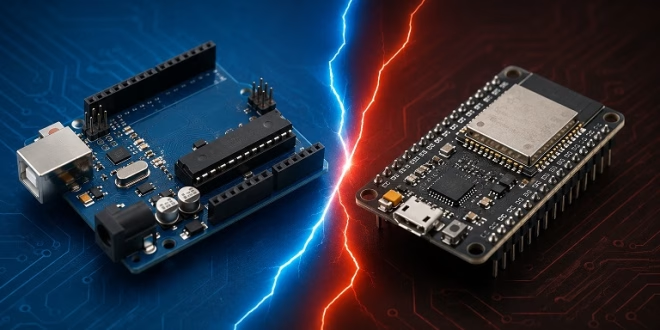
Choosing which microcontroller to use is what proves to be the most important decision when you are beginning an electronics or IoT project. Today, out of the two most popular choices are the Arduino and the ESP32. They both have large communities, which make them great for beginners, but they are put forth for different uses, and also each has its own set of benefits.
In 2026 if you are on the fence between Arduino and the ESP3 this guide provides an overview of the features, performance, connectivity, power consumption, and best use cases of each to help you out.
What Is Arduino?
Arduino is a free electronics platform which was made to simplify the programming and hardware development. It is very popular with beginners, students, hobbyists and professionals as a tool for studying embedded systems and to put together electronic projects.
The most used board is the Arduino Uno which is based on the ATmega328P microcontroller. It is easy to use with the Arduino IDE and has at its disposal a large set of libraries which in turn makes it a great option for beginners in the world of electronics.
Key Features of Arduino
- Beginner-friendly programming environment
- Very large collection of tutorials and libraries.
- Affordable development boards
- Reliable for basic electronics projects
- Large community support
Arduino is a great platform for learning to program, interact with sensors, work with robotics, and basic automation.
What Is ESP32?
ESP32 is a microcontroller that is brought to you by Espressif Systems. Also, unlike the traditional Arduino boards, the ESP32 has built-in Wi-Fi and Bluetooth features, which in turn makes it very much at home in the IoT space.
It has a dual core processor, better clock speed, more memory, and a variety of advanced peripherals. Although it comes with very powerful hardware, the ESP32 is also a great option for beginners, which you can program via the Arduino IDE.
Key Features of ESP32
- Built-in Wi-Fi and Bluetooth
- Dual-core processor
- High processing speed
- Multiple GPIO pins
- Touch sensor support, PWM, ADC, DAC, SPI, I2C, and UART.
- Low-power operating modes
ESP3 at large is used in smart home devices, wireless sensors, industrial automation, and IoT systems.
Arduino vs ESP32: Feature Analysis.
Feature Arduino Uno ESP32 also UNO ESP32 which is also known as.
Arduino vs ESP32: Feature Comparison
| Feature | Arduino Uno | ESP32 |
| Processor | 8-bit ATmega328P | 32-bit Dual-Core Xtensa |
| Clock Speed | 16 MHz | Up to 240 MHz |
| Wi-Fi | No | Yes |
| Bluetooth | No | Yes |
| RAM | 2 KB | Up to 520 KB |
| Flash Memory | 32 KB | Typically 4 MB |
| Analog Pins | 6 | Up to 18 |
| Digital Pins | 14 | More than 30 |
The ESP32 has more to offer in terms of processing power and features; also, Arduino presents a simplified, easy-to-use approach.
Performance Comparison
When in terms of performance, the ESP3 which also goes by the name of Espressif Systems' chip, does very well in comparison to the Arduino Uno.
Its faster processor and larger memory allow it to run many tasks at the same time. Applications like web servers, real-time data logging, image processing, and wireless communication do very well on the ESP32.
Arduino also, in that regard, does well in simple control systems, LED projects, motor control, and educational applications that don’t require high processing power.
Connectivity
Between Arduino and ESP3 that which they connect to is different.
The Arduino Uno does not come with built-in wireless communication. For Wi-Fi or Bluetooth options, you will have to get additional modules like the ESP8266 Wi-Fi module or Bluetooth shields.
The ESP32 has built-in Wi-Fi and Bluetooth, which in turn reduces hardware costs and simplifies development.
If you are to put your project online or have it communicate wirelessly, the ESP32 is the choice for you.
Power Consumption
Although the ESP32 has greater power, it also supports very low power sleep modes.
For which battery-powered IoT devices, the ESP32 has great success in reducing power use during idle.
The Arduino Uno has low power consumption during normal operation, but the ESP32 has more advanced power management features.
Ease of Programming
Both of these boards are very easy to program with the Arduino IDE.
Arduino is the best choice for total beginners due to its simple architecture and large set of educational resources.
The ESP32 does have a steeper learning curve, which is due to its advanced features, but beginners can still pick it up quickly with the same Arduino environment.
Community Support
Arduino is home to the largest electronics community, which is of a global scale. Users have access to thousands of tutorials, forums, libraries, and project examples.
Over the past few years the ESP32 community has grown large. Today developers have access to documentation, open-source projects, and troubleshooting guides for almost any application.
Many developers also use microcontrollers in business automation projects where an accounting virtual assistant can communicate with IoT devices for monitoring, reporting, and workflow management. Industry reports in related automation sectors also mention that 66% report increased productivity after adopting connected technologies and automated digital processes.
Which One Should You Choose in 2026?
Which one you choose depends on your project.
If you are a total beginner in electronics and looking to get into the world of programming and circuit design Arduino is an ideal place to start. It’s simple, stable and has a very large educational community which makes the learning process a pleasure.
Sure, here is the paraphrised version of that text: If you are looking to develop present day IoT devices, wireless automation systems, or advanced embedded projects go for ESP32 which is considered a better investment. It provides you with great performance, in built wireless connectivity, large memory and also includes advanced features at a very competitive price.
Final Thoughts
Both Arduino and ESP32 are very good microcontroller platforms but they have different uses. Arduino does very well in education and for simple electronics projects, at the same time ESP32 is aimed at powerfull connected applications.
In 2026 the ESP32 will have improved as an economical solution for the greater part of new projects which is due to its high performance, integrated Wi-Fi and Bluetooth and full range of hardware features. Also out of the gate Arduino remains a great platform for learning embedded programming as well as to gain knowledge into the basic of electronics.
In the end what you choose is the one which fits your project requirements, experience level, and future development plans.