Most ESP32 development boards are designed for prototyping. Connect a USB cable, upload a sketch, and start experimenting. But when you want to put an ESP32 in an enclosure or …
Read More »-
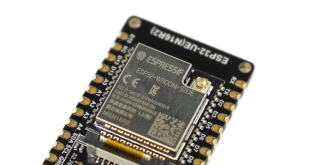
DFRobot FireBeetle 2 ESP32-UE: What Makes This ESP32 Board Different?
-
ESP32 AI Guide: What Can ESP32 and ESP32-S3 Actually Do?
-
ESP32-S31 Explained: Specs, RISC-V, Wi-Fi 6 and ESP32-S3 Comparison
-
ESP32-S3 PSRAM: How to Enable, Detect and Use It in Arduino
-
ESP32-S3 Mini Getting Started Guide: Super Mini Pinout, Arduino IDE Setup, PSRAM and RGB LED
-
Arduino 128×64 LCD Interfacing Using the ST7920
A 16×2 character LCD is enough when you only need to display a few numbers or short messages. However, once your project needs icons, graphs, progress bars, larger fonts, or …
Read More » -
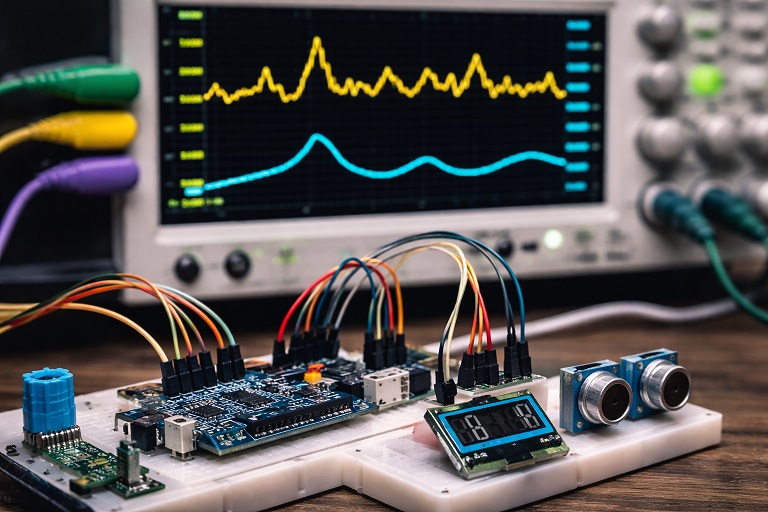
Sensor Reading Filtering (Arduino & Embedded Systems)
-
Using the MH-ET LIVE Scanner 3.0 (QR/Barcode) with Arduino
-
CISC vs RISC for an Arduino User
-
How to Use the PT100 RTD with Arduino Cloud
-
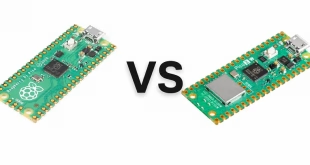
Raspberry Pi Pico vs Raspberry Pi Pico 2: What's the Difference?
The Raspberry Pi Pico 2 looks almost identical to the original Raspberry Pi Pico, but underneath is a significantly more capable microcontroller. The original Pico uses Raspberry Pi's RP2040, while …
Read More » -
RP2040-Zero Getting Started Guide: Pinout, Arduino IDE Setup, and RGB LED Blink
-
Connect L298N to Raspberry Pi 5: Control DC Motors with Python
-
How I Built an Alexa-Like Voice Assistant Using Raspberry Pi 5 and an LLM
-
Using Raspberry Pi Pico as an HID to Control Mouse Movements and Keyboard Strokes
-
ESP32 Captive Portal Rickroll: Create a Wi-Fi Prank
Have you ever connected to Wi-Fi at a hotel, airport, or coffee shop and had a webpage automatically appear? That webpage is called a captive portal. Captive portals are normally …
Read More » -
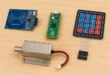
Raspberry Pi Pico Access Control System Using the Elecrow Pico Advanced Kit
-
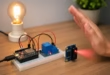
ESP32 Time-of-Flight Sensor Tutorial (VL53L0X / VL53L1X Distance Measurement)
-
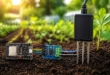
How to Use an NPK Soil Sensor with ESP32
-
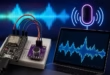
ESP32 + INMP441 I2S Microphone with Live Web Graph
-
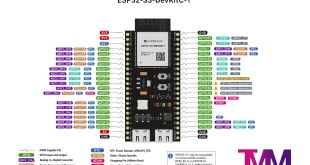
ESP32-S3 Pinout Diagram | ESP32-DevKitC-1
The ESP32-S3 is one of Espressif's most capable microcontrollers, combining Wi-Fi, Bluetooth Low Energy, USB support, a large number of GPIO pins, and hardware intended for signal-processing and AI workloads. …
Read More » -
PID Tuning Calculator: Calculate Kp, Ki and Kd
-
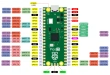
Raspberry Pi Pico 2 Pinout
-
Using a 2-in-1 USB to RS232/RS485 Converter for Embedded Debugging
-
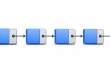
Linked List Visualizer for Embedded Systems