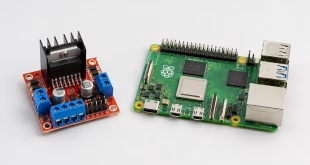
The Raspberry Pi 5 is powerful enough to run vision, robotics, and automation projects, but its GPIO pins cannot directly drive DC motors. A motor needs more current than a Raspberry Pi GPIO pin can provide, and motors also generate electrical noise that can damage sensitive electronics. That is where …
Read More »ESP32-S3 Getting Started Guide: Pinout, Arduino IDE, USB, and First Project
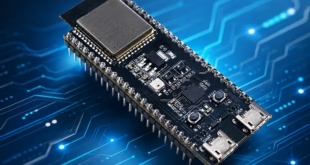
The ESP32-S3 is one of the most useful ESP32 boards for modern microcontroller projects. It keeps the Wi-Fi and Bluetooth features that made the original ESP32 popular, but adds better USB support, more memory options, and features aimed at AI, signal processing, and Human Interface Device applications. If you are …
Read More »ESP32 Async Web Server Event Handler Tutorial
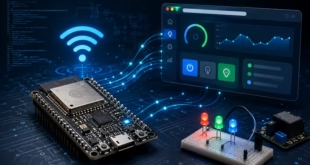
The ESP32 is powerful enough to host a small web server directly on the board. This means you can control LEDs, read sensor values, update a webpage, or build a simple browser-based dashboard without needing a separate computer or cloud server. One of the most useful libraries for this is …
Read More »Arduino ESP32 Autobaud Example: Detect UART Baud Rate Automatically
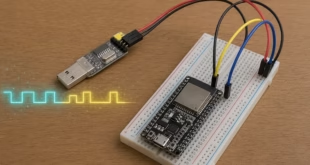
If you are connecting an ESP32 to a UART device, both sides normally need to use the same baud rate. For example, if your external module is sending data at 9600 baud but your ESP32 is listening at 115200 baud, the data will not be read correctly. Fortunately, some ESP32 …
Read More »Understanding -O1, -O2, -O3, -Os, and -Og in Embedded Firmware
flashWhen compiling embedded C or C++ firmware, you will often see compiler flags such as -O0, -O1, -O2, -O3, -Os, and -Og. These are compiler optimization levels. They tell the compiler how much effort it should spend improving the generated machine code. For desktop applications, optimization usually means “make the …
Read More »Structures and Padding in Embedded Systems: Why sizeof() Is Bigger Than You Expect
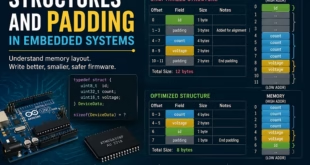
In embedded systems, every byte matters. Whether you are working with a small 8-bit microcontroller, an ARM Cortex-M device, or a memory-constrained IoT module, understanding how data is stored in memory can help you write more efficient and reliable firmware. One common source of confusion is the size of struct …
Read More »Raspberry Pi Pico Access Control System Using the Elecrow Pico Advanced Kit
Access control systems are commonly used in offices, schools, laboratories, apartments, and industrial facilities. At the center of these systems is a controller that decides whether a person is allowed to enter, controls the door lock, and monitors alarm inputs. In this tutorial, I will build a small access control …
Read More »ESP32 Time-of-Flight Sensor Tutorial (VL53L0X / VL53L1X Distance Measurement)
When I first moved from ultrasonic sensors to Time-of-Flight (ToF) sensors, the difference was night and day. Measurements became faster, more stable, and far more precise. In this tutorial, I’ll show you exactly how I use a ToF sensor like the VL53L0X with the ESP32. What is a Time-of-Flight Sensor? …
Read More »How to Use an NPK Soil Sensor with ESP32
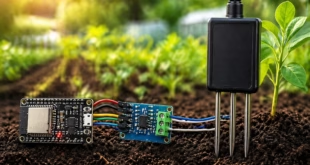
If you are building a smart agriculture project, one of the most useful things you can measure is the nutrient condition of the soil. Moisture sensors can tell you if the soil is wet or dry, but they cannot tell you whether the soil still has enough nutrients for healthy …
Read More »ESP32 + INMP441 I2S Microphone with Live Web Graph
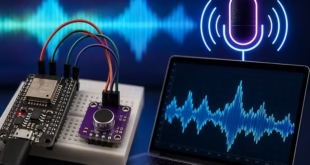
In this project, I’ll show you how I interface the ESP32 with the INMP441 I2S microphone module, starting from basic audio capture and then moving toward a more interactive application where the sound is visualized in real time on a web browser. When I first worked with microphones on microcontrollers, …
Read More »