The ESP32 family has changed quite a bit since the first appearance of the original ESP32. We have had the ESP32-S2, S3, C3, C6 and several other variants aimed at specific applications. Now Espressif has introduced another major member of the family: the ESP32-S31. At first glance, the name makes it sound like a small update to the ESP32-S3. It isn't.
The ESP32-S31 moves to a dual-core RISC-V processor running at up to 320 MHz, adds Wi-Fi 6, brings back Bluetooth Classic, includes an IEEE 802.15.4 radio for Zigbee and Thread, and adds considerably more hardware for displays, cameras, audio and edge AI.
Espressif announced the ESP32-S31 in March 2026 and moved the device into mass production in July. So unlike some chips that remain development announcements for months, the S31 is already moving into development boards and production modules.
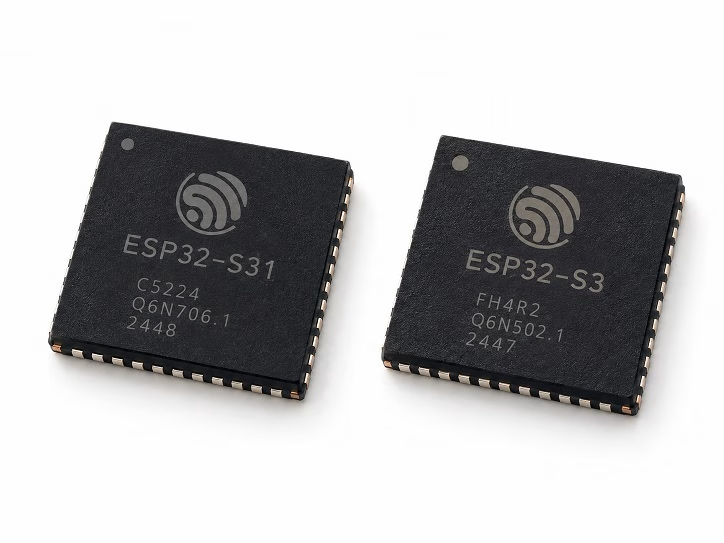
What is the ESP32-S31?
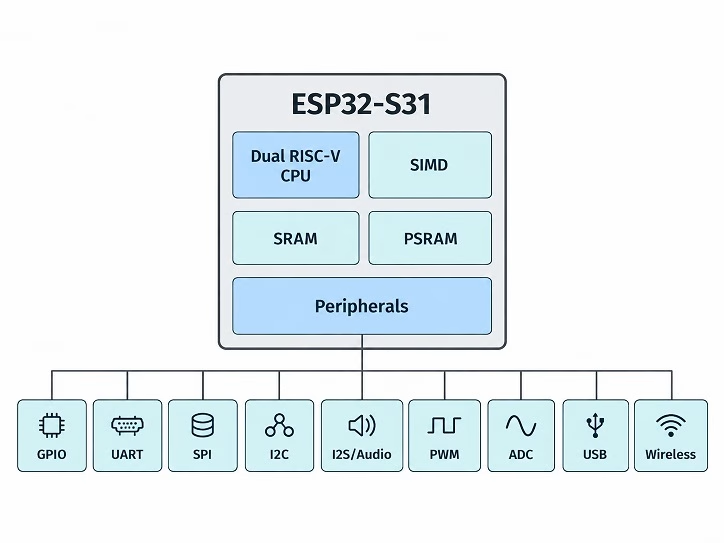
The ESP32-S31 is a high-performance wireless microcontroller from Espressif intended for connected devices that need more processing power and more interfaces than a typical ESP32 application. Its two main processor cores use the 32-bit RISC-V architecture and can operate at up to 320 MHz. One of those cores includes a 128-bit data path and SIMD instructions intended to accelerate operations commonly found in signal processing, image processing and machine-learning workloads.
That already makes the architecture quite different from the ESP32-S3. The S3 uses two Xtensa LX7 cores running at up to 240 MHz.
The ESP32-S31 also provides 512 KB of internal SRAM, while external or in-package high-speed PSRAM can provide much larger working memory for applications such as graphical interfaces, cameras and AI models. Espressif currently lists ESP32-S31 chip variants with 16 MB or 32 MB of in-package Octal SPI PSRAM.
The important specifications can be summarized as follows:
| Feature | ESP32-S31 |
|---|---|
| CPU | Dual-core 32-bit RISC-V |
| Maximum CPU Clock | 320 MHz |
| Internal SRAM | 512 KB |
| External/In-package PSRAM | High-speed 8-bit DDR PSRAM, including 16 MB and 32 MB chip variants |
| Wi-Fi | 2.4 GHz Wi-Fi 6 / 802.11ax |
| Bluetooth | Bluetooth 5.4 LE + Bluetooth Classic |
| 802.15.4 | Yes, for Zigbee and Thread |
| GPIO | Up to 60 programmable GPIOs |
| USB | USB 2.0 High-Speed OTG + USB Serial/JTAG |
| Ethernet | Gigabit Ethernet MAC |
| Camera | 8- to 16-bit DVP |
| Image Acceleration | JPEG codec, PPA and 2D-DMA |
Those specifications put the ESP32-S31 somewhere between the traditional ESP32 microcontrollers and Espressif's more application-processor-like devices.
ESP32-S31 Uses RISC-V
One of the biggest changes is the processor architecture. ESP32-S3 uses Espressif's familiar Xtensa LX7 cores. ESP32-S31 instead uses RISC-V, continuing Espressif's shift toward the open instruction-set architecture already found in chips such as the ESP32-C3 and ESP32-C6.
The two high-performance cores run at up to 320 MHz. Espressif also includes a 40 MHz low-power coprocessor, which allows some monitoring and low-power tasks to continue while the main processors are inactive. The increased clock frequency alone does not explain all of the performance improvement. One CPU core provides a 128-bit data path with SIMD instructions. SIMD, or Single Instruction Multiple Data, allows one instruction to operate on several pieces of data at the same time.
Consider image processing. If an algorithm needs to perform the same mathematical operation on thousands of pixels, processing several pixel values simultaneously can be much faster than processing each one individually. This is also useful for DSP operations, audio processing and neural-network inference. The S31 therefore isn't simply a faster ESP32 for blinking LEDs or reading sensors. Much of its additional hardware makes more sense once the application starts handling large streams of data.
Wi-Fi 6, Bluetooth and 802.15.4
Connectivity is probably the area where the ESP32-S31 separates itself most clearly from the ESP32-S3. The S31 supports 2.4 GHz Wi-Fi 6, or IEEE 802.11ax. Note the 2.4 GHz specification here: Wi-Fi 6 support does not mean that the ESP32-S31 suddenly becomes a 5 GHz Wi-Fi device. Its integrated radio operates in the 2.4 GHz band.
Bluetooth support is also considerably broader. ESP32-S31 supports both Bluetooth 5.4 Low Energy and Bluetooth Classic BR/EDR. This is interesting because Bluetooth Classic disappeared from several newer ESP32 variants, including the ESP32-S3. Bringing it back makes the S31 more useful for applications such as Bluetooth speakers and other devices that still need compatibility with traditional Bluetooth audio. Bluetooth LE support also extends to LE Audio, including the LC3 codec and multi-stream audio capabilities. Espressif specifically highlights audio as one of the intended application areas for the chip.
There is also an IEEE 802.15.4 radio, which provides the hardware foundation for protocols such as Zigbee and Thread. That means one ESP32-S31 can potentially act as a much more capable smart-home controller than an S3. For example, a gateway could communicate with Wi-Fi devices, Bluetooth devices and Thread or Zigbee sensors without requiring separate wireless microcontrollers for every protocol. This also makes the chip particularly interesting for Matter gateways and border-router-style devices.
Gigabit Ethernet
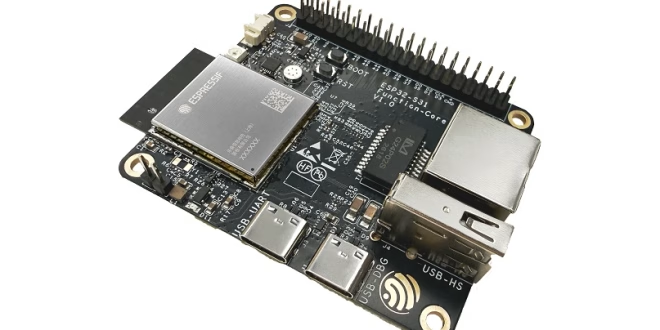
Another surprising addition is a 1000 Mbps Ethernet MAC. The important word here is MAC. The ESP32-S31 does not magically provide an RJ45 Ethernet connection directly from the chip. A design still needs the appropriate external Ethernet PHY and magnetics. Espressif's own ESP32-S31-Function-CoreBoard-1 demonstrates this approach. The board connects the S31's RGMII interface to an external Ethernet PHY and provides an RJ45 connector capable of 10/100/1000 Mbps auto-negotiation. Still, having a Gigabit-capable Ethernet MAC inside an ESP32-class SoC is significant. It makes applications such as network gateways, industrial controllers and high-bandwidth edge devices much more practical.
ESP32-S31 for Displays and Cameras
The S31 is clearly designed for products with more sophisticated user interfaces. It includes a DVP camera interface supporting 8- to 16-bit data, along with several LCD interfaces. These include parallel RGB displays up to 24 bits as well as I8080 and MOTO6800-style interfaces. Hardware can convert between formats including RGB565 and several YUV formats. Espressif also provides dedicated image-processing hardware such as a JPEG codec, Pixel Processing Accelerator (PPA) and 2D-DMA.
Why does that matter? Without dedicated hardware, operations such as moving a framebuffer, resizing an image or handling camera data can consume a large percentage of CPU time. The ESP32-S31 can offload some of those jobs. That gives the main processors more time for application logic, networking or AI inference. Up to 14 capacitive-touch channels are also available, making the chip suitable for touch panels and appliances where physical buttons are being replaced by interactive displays. I can see this being particularly useful for smart control panels, video doorbells, small instrument displays and voice-enabled appliances.
Edge AI on the ESP32-S31
Espressif has been promoting AI capabilities since the ESP32-S3, so we should be careful about what "AI" means here. The ESP32-S31 is not intended to compete with a desktop GPU running a large language model. Instead, its hardware acceleration makes it suitable for smaller edge AI inference tasks where data must be processed directly on the device. Examples include keyword recognition, wake-word detection, image classification, object detection, anomaly detection and signal classification.
The combination of SIMD instructions, a 128-bit data path, hardware image processing, fast PSRAM and dedicated mathematical acceleration makes these workloads considerably more practical than they were on earlier ESP32 devices. Espressif also lists CORDIC acceleration among the S31's dedicated hardware. This also explains the amount of PSRAM available. A simple sensor-reading program doesn't need 16 MB or 32 MB of RAM. Camera frame buffers, graphical interfaces, neural-network tensors and audio buffers certainly can.
Peripheral Interfaces
Despite its emphasis on multimedia, the ESP32-S31 is still a microcontroller. The chip provides traditional interfaces such as SPI, I2C, UART, I2S, PWM and GPIO alongside newer or higher-performance peripherals. It includes four main-system UART controllers plus a low-power UART. SPI interfaces support normal SPI as well as Dual, Quad and, on some controllers, Octal operation. There are also two high-performance I2C controllers plus a low-power I2C interface.
USB receives a major upgrade to USB 2.0 High-Speed OTG. High-Speed USB is a substantial improvement over the USB Full-Speed interface found on the ESP32-S3. The S31 also includes interfaces for CAN FD, SD/MMC, motor-control PWM, LED PWM, RMT, pulse counting and parallel I/O. On the analog side, the documentation lists ADC, DAC, a temperature sensor, touch sensing and an analog voltage comparator. With up to 60 programmable GPIOs, larger designs are less likely to run into the pin limitations that sometimes appear when an ESP32 project starts combining a display, camera, external memory and several peripherals.
ESP32-S31 vs ESP32-S3
The S31 may look like the natural replacement for the ESP32-S3, but that doesn't mean every S3 project needs one.
| Feature | ESP32-S31 | ESP32-S3 |
|---|---|---|
| CPU | Dual-core RISC-V | Dual-core Xtensa LX7 |
| Maximum Clock | 320 MHz | 240 MHz |
| Internal SRAM | 512 KB | 512 KB |
| Wi-Fi | 2.4 GHz Wi-Fi 6 | 2.4 GHz Wi-Fi 4 |
| Bluetooth LE | Bluetooth 5.4 | Bluetooth 5 |
| Bluetooth Classic | Yes | No |
| Zigbee / Thread Radio | Yes | No |
| GPIO | Up to 60 | Up to 45 |
| USB | USB 2.0 High-Speed | USB 2.0 Full-Speed |
| Ethernet MAC | Gigabit | No equivalent integrated Gigabit MAC |
| AI / Multimedia Hardware | Expanded SIMD, JPEG, PPA, 2D-DMA and other accelerators | SIMD/vector acceleration |
Espressif itself recommends the S31 for gateways, bridges and AI multimedia devices where multi-protocol connectivity or higher processing performance is important. The company still recommends the S3 for more cost-sensitive applications that don't need these capabilities. That seems like the sensible way to look at the two chips.
If your project is reading an I2C sensor and uploading a value to an MQTT server, an ESP32-S31 would probably be excessive. If your project combines a camera, display, voice interface, Wi-Fi, Bluetooth and Thread, then the advantages start to become obvious.
ESP32-S31 Modules and Development Boards
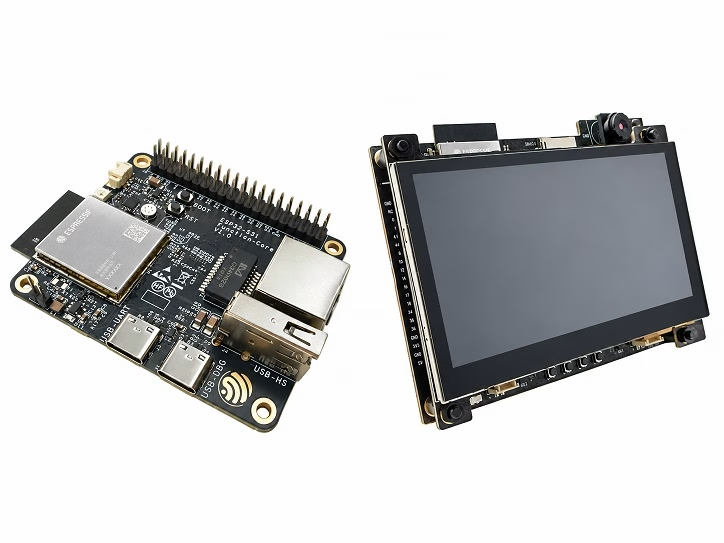
Espressif is already offering modules around the new chip. The ESP32-S31-WROOM-1 family is listed with different flash and PSRAM capacities, while the ESP32-S31-WROOM-3 is being used on Espressif's multimedia and function development boards.
One interesting example is the ESP32-S31-Korvo-1. This development board is clearly aimed at showing what the chip can do beyond ordinary IoT sensing. It includes audio hardware, dual microphones, speaker outputs, microSD support, USB High-Speed connectivity and connectors for an LCD and camera. A current WROOM-3 configuration used by the board includes 16 MB flash and 16 MB PSRAM. Espressif also provides the ESP32-S31-Function-CoreBoard-1, which adds Gigabit Ethernet and audio hardware while breaking out the important GPIO connections.
Programming the ESP32-S31
For now, ESP-IDF is the safest development environment for the ESP32-S31. Espressif says S31 support is available in the ESP-IDF master and v6.1 branches, with official tagged support planned from ESP-IDF 6.1.1 onward. Arduino support is a different story.
As of September 2026, the stable Arduino-ESP32 documentation still does not list the S31 among officially supported SoCs. Espressif developers have been working on S31 support for Arduino 4.x, which is based on ESP-IDF 6.1, but the Arduino team's current roadmap places the 4.0 release in November 2026. So if you purchase an ESP32-S31 board today expecting exactly the same Arduino IDE experience as an ESP32-S3 DevKit, expect some rough edges.
For developers already comfortable with ESP-IDF, however, the S31 can already be explored properly. This situation should improve as the software ecosystem catches up with the hardware.
Security Features
The ESP32-S31 also includes considerably more security hardware than is necessary for the average hobby project, but that becomes important in commercial products. The chip supports secure boot, flash and PSRAM encryption, hardware cryptographic acceleration and protected key handling. Hardware support includes AES-128/256, RSA, ECDSA and ECC operations. Espressif also includes TRNG and a RAM-based physical unclonable function, or PUF, as part of its security architecture.
Flash encryption uses XTS-AES-256, while secure boot can verify signed firmware before it executes. Together, these mechanisms make it more difficult to extract proprietary firmware or replace legitimate software with unauthorized code. These features may not matter while experimenting with a development board, but they become very important once an ESP32-based product leaves the lab.
Who is the ESP32-S31 For?
The ESP32-S31 makes the most sense when several previously separate requirements start appearing in the same project. A smart-home gateway is one example. It may need Wi-Fi for the local network, Thread or Zigbee for sensors, Bluetooth for commissioning, Ethernet for reliable wired connectivity and enough processing power to run local automation logic.
A smart display is another. Now the device may need LCD graphics, touch input, audio, Wi-Fi, Bluetooth and perhaps a camera. The same applies to voice assistants, industrial gateways, security panels and camera-based edge devices. For those applications, the ESP32-S31 can potentially replace several chips with one highly integrated SoC.
For basic sensor nodes and conventional ESP32 projects, however, the S31 is unlikely to make the ESP32-S3, C3 or C6 obsolete. Those devices are cheaper, mature and already have a large software ecosystem.
Final Thoughts
The ESP32-S31 feels less like another variation of the ESP32 and more like Espressif stretching the definition of what an ESP32-class microcontroller can handle. You still get familiar microcontroller peripherals such as GPIO, SPI, I2C, UART and PWM. But those now sit beside a 320 MHz dual-core RISC-V processor, high-speed PSRAM, Wi-Fi 6, Bluetooth Classic and LE, Zigbee/Thread connectivity, High-Speed USB, Gigabit Ethernet, camera and display interfaces, and dedicated multimedia accelerators.
The hardware is impressive. The main limitation right now is software maturity. ESP-IDF is already the primary path for development, while Arduino support is still catching up. For developers who depend heavily on mature Arduino libraries, the ESP32-S3 remains easier to use today. But once the ecosystem matures, the ESP32-S31 could become one of Espressif's most interesting devices for smart displays, gateways, audio products and edge-AI projects. And considering how many interfaces Espressif has managed to put into a single microcontroller, there should be plenty of projects worth testing on it.