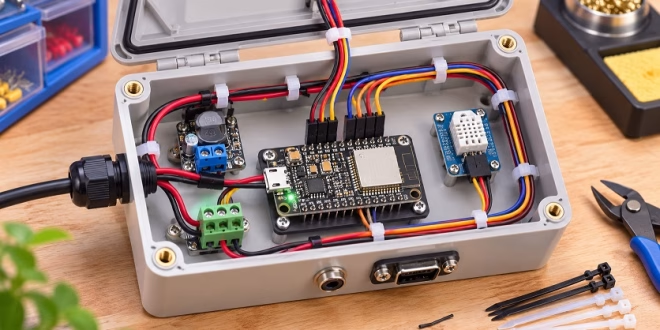
A microcontroller project usually starts on a breadboard and ends in a box. Once the board, power supply, sensors and connectors are inside an enclosure, the wiring decides whether the build is reliable. Loose jumper wires work free, rub against sharp edges or pull on solder joints.
Cable ties are the simplest fix, but only when they are the right size and used correctly. This guide covers the choices that matter in small electronics enclosures.
Why wiring fails inside enclosures
Most failures in finished electronics projects are mechanical, not electrical:
- Pulled connectors: a cable is tugged during assembly and a Dupont or JST pin backs out.
- Cracked solder joints: an unsupported wire flexes at the joint every time the lid is opened.
- Chafed insulation: wires rub on a metal edge or a heatsink until a conductor is exposed.
- Blocked airflow: a tangle of wires sits over a voltage regulator or driver chip.
Tying wires into tidy, supported bundles prevents all four.
Pick the right size
Small enclosures need small ties. A standard 4.8 mm tie is too bulky for a project box and its sharp cut tail can scratch nearby components.
| Use inside the enclosure | Tie size | Typical loop tensile strength |
|---|---|---|
| Sensor leads, jumper wires, ribbon cables | Mini, 2.5 mm wide, 100 mm long | 18 lb (8 kg) |
| Power leads, small bundles of 5 to 10 wires | 3.6 mm wide, 150 mm long | 40 lb (18 kg) |
| Mains input cable strain relief | 4.8 mm wide | 50 lb (22 kg) |
For most hobby and prototype builds, a pack of 2.5 mm mini ties covers almost everything.
Choose the material for the environment
- Natural nylon 66 is fine for indoor projects. It is flexible, cheap and easy to cut.
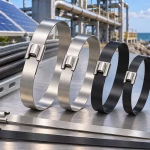
- UV-stabilised black nylon is needed for anything outdoors, such as weather stations, garden sensors and solar-powered nodes. Natural nylon turns brittle in sunlight within months.
- Releasable ties are useful in prototypes you will keep modifying. They open and close without cutting.
If the project will be sold or installed in a building, check the flammability rating of the tie material. Ties made from UL 94 V-2 rated nylon are a common baseline.
Give every cable strain relief
Strain relief means the cable, not the connector or solder joint, takes the pulling force.
- Fix a cable tie mount or a screw boss near where the cable enters the box.
- Tie the cable to that point with a little slack between the tie and the connector.
- For mains or power input, use a cable gland or grommet at the hole, then a tie inside as a second stop.
Adhesive tie mounts are fine for light signal wires. Use screw mounts for anything heavier or for boxes that get warm, because the adhesive can soften with heat.
Route wires before you tie them
- Separate power wiring from signal and data lines. Run them along different sides of the enclosure to reduce noise.
- Keep wires away from heatsinks, regulators and motor drivers.
- Leave a service loop so the lid can open without stretching any cable.
- Tie bundles every 50 to 100 mm in a small enclosure.
Common mistakes
- Over-tightening. A tie pulled hard with pliers can crush thin insulation and deform ribbon cables. Pull the tie snug by hand, or use a tensioning tool.
- Leaving long tails. Cut tails flush. Angled cuts leave a sharp point that can scratch a PCB or your fingers.
- Tying directly to the PCB. Never loop a tie around components. Use the board's mounting holes or a nearby mount instead.
- Bundling antenna wires. Keep Wi-Fi, LoRa and GPS antenna leads apart from other wiring.
From one project to production
A hobby build needs one mixed pack. A product that ships in hundreds or thousands needs a fixed list of tie sizes, a reliable supply and consistent quality, because one weak batch can mean field failures.
When a design moves to production, buying direct from a nylon cable ties factory gives you consistent material and lower unit cost. Ask for samples, the resin's flammability rating and a quotation before you commit. Suppliers such as cabletiesmanufacturer.com produce nylon 66 ties, mini ties and mounts in bulk for electronics assemblers.
Quick checklist
- Mini 2.5 mm ties for signal wiring, larger ties only for power leads
- UV black ties for outdoor builds
- Strain relief at every cable entry
- Power and signal routed apart, away from hot parts
- Ties snug, not crushing; tails cut flush
- Service loop so the lid opens freely
Conclusion
Neat wiring is not just about looks. In a small enclosure it prevents pulled connectors, cracked joints and short circuits. Choose small ties, add strain relief, route power and signal apart, and your project will survive far longer outside the breadboard.