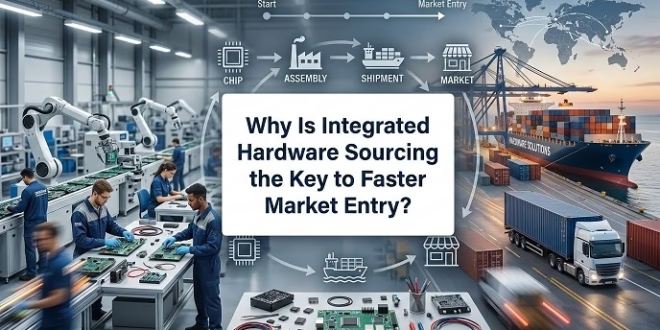
Getting a product to market quickly isn't just a competitive advantage anymore, it's survival. For products with short product lifecycles and even shorter customer expectations, the difference between “almost ready” and “shipping now” can be the difference between success and failure.
However, one of the biggest challenges in that journey that's often missed is not design, funding and even manufacturing! It's sourcing. Actually its fragmented sourcing, which essentially amounts to the expensive practice of viewing each hardware component as a standalone procurement issue.
The Hidden Cost of Fragmentation
Suppose you're designing a consumer electronics device. PCBs are being built by one vendor, wiring harnesses by another, enclosures by another, and perhaps even sensors from another. Vendors vary in their lead times, their communication style, their quality standards and their approach to issues if things go wrong.
Multiply each of these co-ordination difficulties in all of those relationships. No, that is not a supply chain, it is a maze. Delays compound:
- If the shipment is late, it delays the next step.
- One vendor has a quality problem that can cause a domino effect of re-scheduling calls throughout the other vendors.
- Then, there's your launch date which quietly passes in the middle of all of this.
It is the fragmentation tax and most hardware companies pay this tax without ever naming it.
What is Integrated Sourcing in Reality?
Integrated hardware sourcing is not only the use of smaller supplier numbers, it is the approach to the supply chain as a system, instead of a series of transactions. With components also sourced via a coordinated network of manufacturers, communication is more fluid, timelines more aligned and problems are identified earlier as the people involved are talking to each other.
Don't imagine ordering from a menu, think of it as a team that has worked on the project.
The benefits to companies creating complex electronics are seen quickly. When manufacturing PCBs in Japan, having a manufacturer with experience like PCB assembly Japan not only provides technical precision but also an entire ecosystem of material suppliers, testing procedures, and process standards that seamlessly complement each other. When it works, you don't see that integration, and when it doesn't, it is so painful.
Speed Isn’t Just About Manufacturing
One thing that a lot of teams, new to hardware development, don't realize is that the manufacturing process is not the process that takes the most time. The true time is spent before and after, during:
- The back-and-forth of the quotation process.
- The mismatch of expectations between design and production.
- The re-spinning due to component incompatibility.
Integrated sourcing bridges those gaps. If your PCB assembler and wiring harness supplier have the same standards or they're part of networked systems, they're already taking care of compatibility. You are not getting fit problems three weeks before the date of your shipment.
Regional Ecosystems
Southeast Asia has become a hotspot for just such integrated thinking. Wiring harness thailand have established whole manufacturing ecosystems to cater the needs of multinational OEMs requiring speed without compromising reliability. These partnerships are not simply cost driven as there is proximity to wider regional supply chains, flexibility between production scales and extensive knowledge of quality standards internationally.
The Quality-Speed Tradeoff Is a False Choice

Many teams think that if they can go faster, they will have to take more risks. In a disorganized supply chain, that is frequently the case. However, integrated sourcing turns the tide around.
Quality control isn't just done at the end when your suppliers are actually coordinated, it's done within the handoffs. The components leaving one stage of production are already validated for the next stage of production. That is how you deal with issues before they spread far and wide downstream.
That is the reason why manufacturing partnerships in Northeast Asia understand very well. When you work with a supplier network that leverages PCB assembly Korea capabilities, you may also find that they have facilities where process integration is a specialty in other words, where the movement from bare board to assembled unit is not only designed to reduce costs but also to reduce variation.
Relationships Are Infrastructure
What every hardware team knows, and new hardware teams take to heart: supplier relationships are infrastructure. They are not something that can be developed overnight and not something that can be replaced instantly, if something goes wrong.
Relationship-building is by design in integrated sourcing:
- Frictionless Onboarding: Having common vendors or prior relationships with them makes it easier for you as a new buyer to enjoy the benefits of their relationships.
- Goodwill: People will be more willing to work late to meet a deadline when there is goodwill in the room.
- Institutional Knowledge: Suppliers with experience in challenging supply environments, such as wire harness south korea, are more likely to offer the precision and process discipline required.
This knowledge is not only good for quality, but it also makes collaboration quicker and more dependable on each and every project.
Practical Steps for Hardware Teams
Hardware teams can gain from these insights by taking practical steps to enhance their operations. Whether you're going through your first or fifth product launch, there are some things to consider:
- Map your timeline after you map your dependencies! Know which products rely on which and which supplier relationships are most critical. That's where integrated sourcing comes in.
- Optimize for handoff quality, rather than individual component specs. An on-time, in-sync, but wrong PCB doesn't help anybody. Think systemically.
- Get ready for supplier relationships before you need them. Those companies that move fastest do not necessarily have the most aggressive timelines, they are simply the ones able to execute within their timelines because they've built supply chains that can do it.
The Bottom Line
The faster market entry is not about working harder or harder sells, harder vendors. It is derived from the creation of a moving supply chain, that is, a chain in which each piece is designed to fit into place.
The key to achieving this is integrated hardware sourcing. It's not showy and it's not a showy product release. However your pay off is when your launch goes well and your team reaches its milestone and your product is out to customers before your competition. But it begins with thinking of sourcing not as logistics, but as strategy.