As you look for a stable and wired internet connection for your new home office or movie centre, you find that there is already an electrical conduit running right where you want it to go! What a great road you were given through your walls! Pause for a second and ask yourself, "How much is too much?" before you put any wires in that opening. A neat, cool, and organised way to improve your home network is to run networking wires down an existing conduit. But there is a very thin line between a nice show and one that is so crowded that it doesn't work well. Let's walk through how to do it right, ensuring your network is both fast and future-proof.
The “Why” Behind Conduit
That pipe is more than just a pipe; it's a safe, specialised path for your wiring. It protects the wires from getting nicked by a nail, pinched by moving drywall, or damaged by water. Most people think of conduit when they think of high-voltage lines, but it's also the best way to run low-voltage cables like Ethernet, coaxial, and fibre optics. It keeps your installation very clean, protects it from interference, and makes it easy to make changes in the future. Being aware of its physical limits is important so that that open highway doesn't become a frustrating traffic jam.
Respecting the Golden Rule: Conduit Fill Capacity
Now we get to the important part. You can't just keep pulling wires through a conduit until there are no more spaces left. There is a scientific term for this called "conduit fill capacity," which tells you how much of the inside of the conduit can be safely filled with wires. There are good reasons why national and local electrical rules are very strict about this.
A lot of bad things can happen if you overfill a pipe. Heat is a big problem for network lines. The heat from a tight bundle of Ethernet wires can still get warm, though not as much as the heat from power lines. Without airgaps to let the heat escape, high temperatures can damage the cable's wiring over time, which can slow it down and cause data mistakes. The chance of damage happening during the pull is another big problem. When you force too many cables through a small space, there is a lot of friction, which can quickly wear away the jacket that protects the cables. This can cause kinks, breaks in the wires inside, and a link that doesn't work at all.
As a general rule, when running multiple wires, your bundle shouldn't take up more than 40% of the cross-sectional area of the conduit. This makes it possible for air to flow and makes pulling the wires much easier. To figure this out on your own, you'll need to find the conduit's and cables' areas. Luckily, you don't have to deal with complicated math if you use an online electrical conduit fill calculator. You only need to know how big your conduit is and how wide your network wires are.
Sizing Up Your Cables
There are different kinds of Ethernet connections, especially when it comes to their size. There is a very small difference in diameter between a Cat5e, a Cat6, and a Cat6a wire. But in a conduit that is already full, that difference is very important. Cat6 cables are usually bigger than Cat5e cables because they have a plastic spine, or spline, that separates the twisted pairs to cut down on interference. A Cat6a cable, which is designed for lightning-fast 10-Gigabit speeds, is even stronger because it has bigger insulation and stronger shielding. Before you buy that 500-foot spool, look at the "Outer Diameter" (OD) specs from the maker. You'll use this number to figure out how much fill to use.
The Art of the Pull
Once you've done the math and made sure your plan will work, it's time to do the work. It is important to plan for this step because a tricky run with a lot of turns can feel like figuring out a tricky puzzle. You need the right approach to get to the bottom of the problem and find a simple answer.
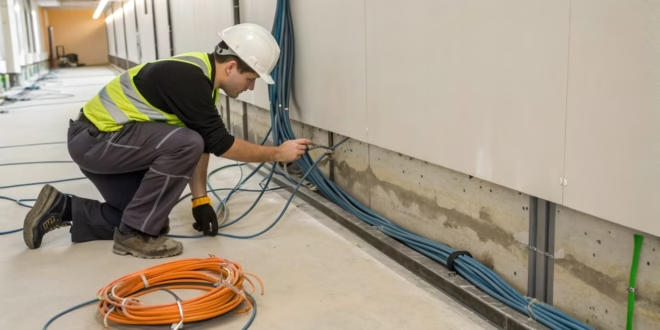
Fish tape is the most important tool for the job. It's a long, flexible strip of steel or fibreglass that you'll use to move wires through conduit. To begin, push the fish tape all the way through the pipe. When the tip of the tape shows on the other side, tightly connect some network wires to the end of the fish tape. Spread out the ends of the wire a little and wrap them tightly with electrical tape to make a smooth, tapered shape that won't catch on bends or joints.
One great tip is to use lubricant for pulling wires. The non-conductive glue that is slippery is made just for this job. It will cut down on friction a lot, which will make pulling the cable easy and safer. Spread a lot of it on the front of the wire bundle and even a little inside the conduit mouth. If you want to label those pulls in a way only you’ll understand, run the labels through an Atbash cipher encoder/decoder first. It would be great if you had a friend to help. The cables are fed into the conduit by one person who makes sure they don't twist or tangle. The fish tape is slowly pulled from the other end by the other person.
Conclusion: Plan, Pull, and Enjoy
A smart and effective way to improve your home or office connections is to run new network lines through conduit that is already there. It's not brute force that will get you ahead, but careful planning. You can avoid a lot of trouble and make sure the installation goes smoothly by learning about conduit fill capacity, picking the right wires for your needs, and the right way to pull them. Your prize will be a network that is fast, stable, and well hidden. It will serve you well for years to come.