Artificial intelligence often brings to mind powerful GPUs, huge servers, and applications like ChatGPT. An ESP32, meanwhile, is a microcontroller with only a fraction of the processing power and memory of a modern computer. Surprisingly, these two worlds are becoming increasingly connected.
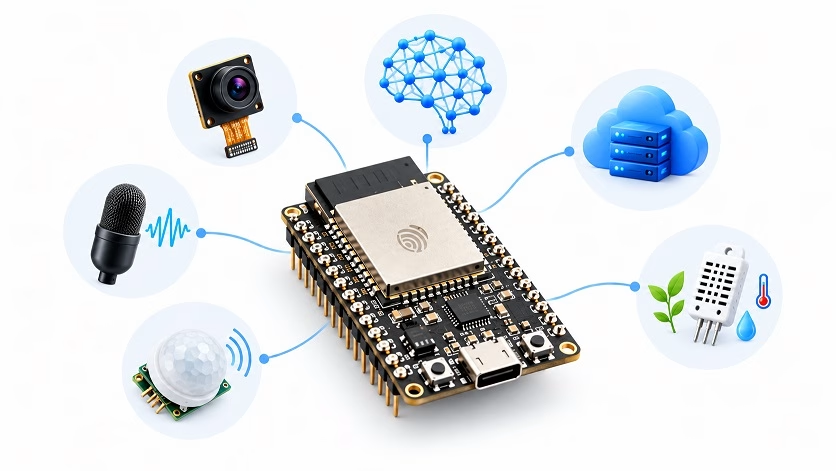
An ESP32 can run small machine-learning models locally, recognize voice commands, classify sensor data, process images, and even communicate with much larger AI models through the Internet. Newer devices such as the ESP32-S3 are especially interesting because Espressif added processor instructions that accelerate neural-network and signal-processing operations.
However, the term ESP32 AI can mean several different things. It may refer to TinyML running directly on the microcontroller, an ESP32 acting as a client for cloud-based AI, an AI camera project, or even the popular AI-Thinker ESP32-CAM board. In this guide, I will separate those concepts and look at what AI on an ESP32 can realistically do.
What Does ESP32 AI Mean?
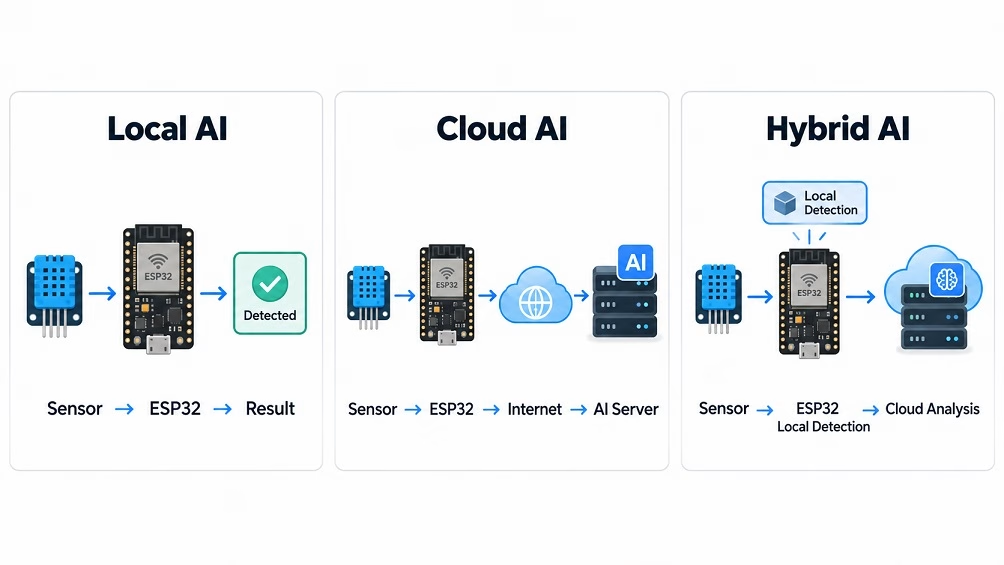
There isn't one specific technology called "ESP32 AI." Instead, there are several ways to combine artificial intelligence with an ESP32. The most important distinction is where the AI model actually runs.
1. AI Running Directly on the ESP32
In this setup, the trained machine-learning model is stored in the ESP32's flash memory and inference occurs directly on the microcontroller. For example, a microphone could continuously listen for the words "ON" and "OFF." Instead of sending every audio sample to a server, the ESP32 processes the audio locally and decides which word it heard. This is often called edge AI, embedded machine learning, or TinyML. I already have a complete TinyML with ESP32 tutorial that covers the model-training and deployment process in detail. This article will focus more on what is possible and which approach makes sense for a particular project.
2. ESP32 Connecting to Cloud AI
The ESP32 does not necessarily have to run the AI model. Because it has Wi-Fi, the ESP32 can collect data and send it to an AI service running on a much more powerful server.
The basic architecture looks like this:
Sensor / User
     |
     v
   ESP32
     |
   Wi-Fi
     |
     v
 Cloud AI / LLM
     |
     v
   ESP32
     |
     v
 Display / Relay / Speaker / Actuator
I used this method in my ESP32 and LLM project using OpenRouter. The ESP32 sends a prompt over Wi-Fi while the actual language model runs remotely.
3. ESP32 as Part of an AI System
There is also a middle ground. An ESP32 might preprocess sensor data locally and only send interesting events to a server. For example, it could detect unusual vibration using a small local model and then send the captured data to a more powerful AI service for further analysis. This hybrid approach can reduce bandwidth while still allowing the system to use large models.
ESP32 AI vs AI-Thinker ESP32-CAM
One source of confusion is worth clearing up early. Searching for "ESP32 AI" often returns results involving the AI-Thinker ESP32-CAM. Despite the name, AI-Thinker is the manufacturer/brand associated with the module. The "AI" in AI-Thinker does not mean that the ESP32-CAM itself contains a dedicated artificial-intelligence processor. The ESP32-CAM is still useful for AI projects because it combines an ESP32 with a camera. Images can either be processed locally with sufficiently small models or sent to another device or server for more demanding computer-vision tasks.
So:
| Term | Meaning |
|---|---|
| ESP32 AI | Using artificial intelligence or machine learning with an ESP32 |
| AI-Thinker | A hardware/module manufacturer |
| AI-Thinker ESP32-CAM | An ESP32 camera board commonly used for vision projects |
The two concepts overlap, but they are not the same thing.
Can an ESP32 Really Run Artificial Intelligence?
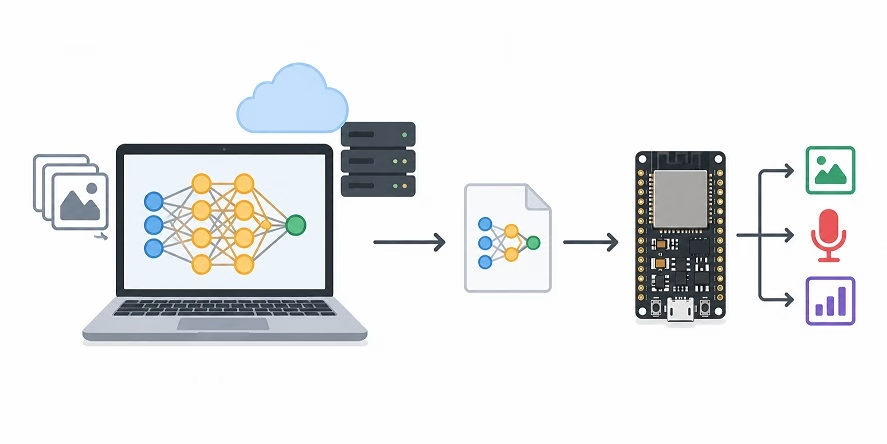
Yes, but the important word is inference. Most ESP32 AI projects do not train their neural networks on the microcontroller. Training might require thousands or millions of calculations performed repeatedly over a large dataset. Instead, training normally takes place on a PC or cloud platform. Once training is finished, the much smaller resulting model is exported and placed on the ESP32.
The workflow therefore looks like this:
Collect Data
     ↓
Train Model on PC / Cloud
     ↓
Optimize / Quantize Model
     ↓
Convert Model for ESP32
     ↓
Flash Model to ESP32
     ↓
Run Inference Locally
Inference simply means giving an already-trained model some new input and asking it for a prediction.
For example:
Microphone sample
       ↓
Machine-learning model
       ↓
"ON" = 92%
"OFF" = 5%
"Other" = 3%
This is a much smaller job than training the network from scratch.
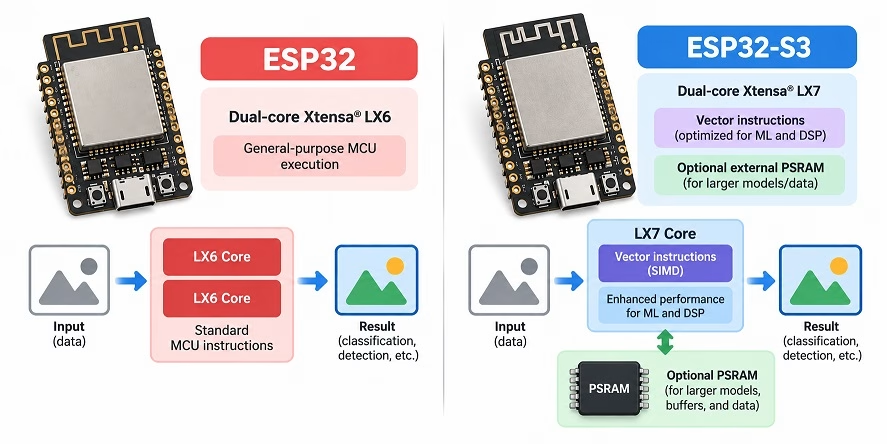
Why the ESP32-S3 Is Better for AI
The original ESP32 can run small machine-learning models, and that is exactly what I used in my earlier TinyML projects. However, if I were buying a board specifically for a new ESP32 AI project today, I would normally choose an ESP32-S3, preferably a version with PSRAM. The ESP32-S3 includes vector instructions that accelerate operations commonly found in neural networks and digital signal processing. It is important to describe this correctly: the ESP32-S3 does not have a large dedicated neural-processing unit comparable to the AI accelerator found in some application processors. Instead, its processor includes instructions that make certain mathematical operations considerably more efficient.
This matters because neural networks repeatedly perform operations such as multiplication and accumulation:

where:
- x represents input values,
- w represents trained weights,
- b is the bias, and
- y is the resulting output.
A neural network may perform these operations thousands or millions of times for a single inference. The ESP32-S3 can therefore execute appropriately optimized models faster than a classic ESP32.
PSRAM Also Matters
Processor speed isn't the only limitation. A machine-learning model needs memory for:
- model weights,
- input data,
- intermediate layer outputs,
- the tensor arena or working memory, and
- your normal application code and buffers.
For very small sensor models, internal RAM may be enough. Camera and audio applications become much more demanding. An ESP32-S3 board with external PSRAM gives you considerably more room for frame buffers and larger models. That does not mean PSRAM automatically makes inference fast. External memory is generally slower than internal SRAM. However, having a slower place to store something is much better than not having enough memory to run the model at all.
What Kind of AI Can an ESP32 Run?
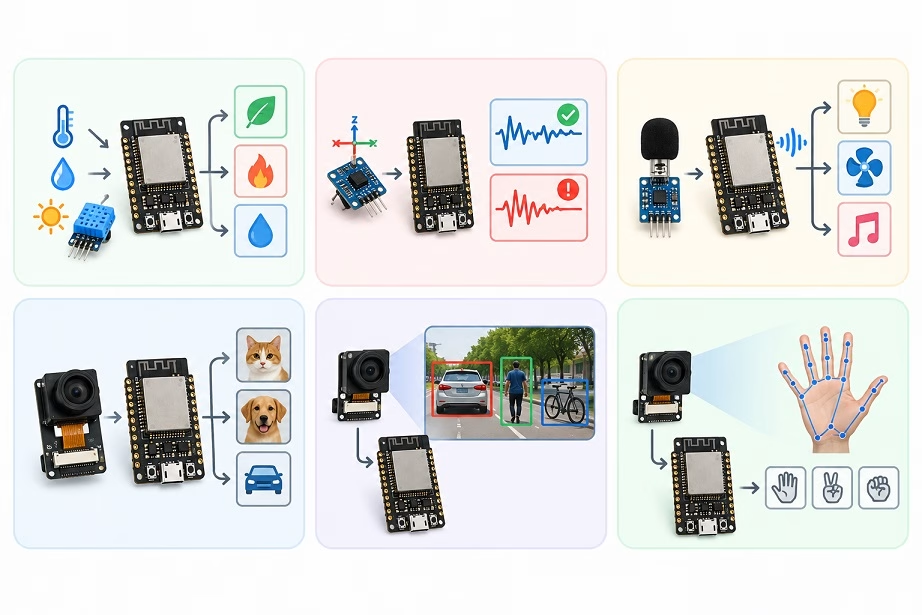
"AI" covers an enormous range of applications. Some are well suited to microcontrollers while others are completely unrealistic. Here are several applications that fit the ESP32 particularly well.
Sensor Classification
This is one of the easiest places to start. Suppose an accelerometer is attached to a machine. Instead of simply checking whether vibration exceeds a fixed threshold, a trained model could classify several operating states:
- normal operation,
- idle,
- unbalanced load,
- excessive vibration,
- possible fault.
The input consists of relatively small numerical datasets, so the model can also remain small.
Anomaly Detection
Instead of teaching the ESP32 every possible fault condition, a model can learn what normal sensor readings look like and identify unusual patterns. Possible applications include:
- machine condition monitoring,
- water pump monitoring,
- battery monitoring,
- unexpected power consumption, and
- environmental sensors.
This is an area where embedded AI can be more useful than simply putting a fixed threshold inside an if() statement.
Voice and Sound Recognition
Audio is another good match for the ESP32-S3. Instead of converting speech into arbitrary sentences, a small model might recognize a limited vocabulary such as: LIGHT, ON, OFF, FAN, OPEN, CLOSE
That task is much easier than full speech-to-text. I have a separate ESP32 TinyML voice command project using Edge Impulse for a practical example.
Other audio applications include:
- glass-breaking detection,
- alarm detection,
- machine noise classification,
- clap or sound recognition, and
- wake-word detection.
Image Classification
A camera image can be reduced to a small resolution and passed through a lightweight neural network. The output could answer a question such as:
Is this object:

Person       0.91
Cat          0.05
Background   0.04
This is more realistic for an ESP32 than asking it to fully understand a high-resolution image.
Object Detection
Object detection is harder than simple image classification because the model must determine both what an object is and where it appears in the image. Optimized object-detection models can run on newer ESP32 hardware, but memory usage and inference time quickly become important. For a battery-operated camera expected to recognize one or two objects, an ESP32-S3 may make sense. For multi-object high-resolution detection at high frame rates, a Raspberry Pi or more powerful processor is normally a better choice.
Gesture Recognition
Gesture recognition can use either camera images or motion sensors. An accelerometer-based gesture recognizer is particularly attractive because the input data is tiny compared with an image. You could teach a device to recognize different movements and perform commands without buttons.
On-Device ESP32 AI vs Cloud AI
Running a model locally is not automatically better.
The right solution depends on what the project needs.
| Feature | On-Device AI | Cloud AI |
|---|---|---|
| Internet required | No | Usually yes |
| Latency | Very low for suitable models | Depends on network/server |
| Model size | Very limited | Can be enormous |
| Privacy | Data can remain local | Data normally leaves device |
| Operating cost | No per-request API fee | May have API charges |
| AI capability | Specialized tasks | Complex vision, speech and LLMs |
| Offline operation | Yes | No |
For example, imagine a smart door. A local ESP32 model could detect a particular sound or wake word without sending continuous microphone recordings anywhere.
However, if you want the user to ask:
"Was anyone standing near the front door while I was away this afternoon?"
that is a much more complicated task. Sending selected images or event data to a larger AI model would make more sense.
ESP32 AI Frameworks and Tools
There are now several ways to deploy AI models on ESP32 devices.
TensorFlow Lite for Microcontrollers
TensorFlow Lite for Microcontrollers, commonly called TFLM, is designed to run neural-network inference on microcontrollers with limited RAM. It is useful when you want to understand the model deployment process more directly. I have a separate TensorFlow Lite on ESP32 tutorial with a voice activity detection example.
ESP-DL
ESP-DL is Espressif's neural-network inference framework for ESP devices. Its current toolchain can take trained models, quantize them, and convert them into a format optimized for supported Espressif chips. This is particularly interesting for ESP32-S3 projects because the framework can make use of optimized kernels for the chip. If I were developing a new performance-sensitive ESP32-S3 AI project, ESP-DL would be one of the first frameworks I would investigate.
ESP-WHO
ESP-WHO is aimed more specifically at computer-vision applications.
Typical applications include:
- face detection,
- face recognition,
- camera-based classification, and
- other embedded vision projects.
It is therefore worth checking when your ESP32 AI project starts with a camera rather than a microphone or sensor.
ESP-SR
For audio applications, Espressif also provides ESP-SR. It contains components for functions such as:
- audio front-end processing,
- wake-word detection, and
- speech-command recognition.
For a product that only needs to understand a limited command vocabulary, this is much more realistic than running a general speech-to-text model.
Edge Impulse
Edge Impulse provides a higher-level workflow for collecting datasets, extracting features, training models, and deploying them to embedded devices. It is especially convenient when experimenting with:
- accelerometers,
- microphones,
- environmental sensors, and
- small image datasets.
It can save a lot of setup time when your main goal is testing whether machine learning improves the project rather than building the ML toolchain yourself.
How Much Faster Is ESP32-S3 for AI?
This is something I prefer to measure rather than answer only from specifications. A useful experiment is to run the same small neural-network model on a classic ESP32 and an ESP32-S3. The model from my existing TinyML tutorial can be reused so that the network itself remains constant.
The important measurements are:
- model size,
- inference time,
- available heap before loading the model,
- available heap while the model is running, and
- whether PSRAM is required.
Inference time can be measured around the model's Invoke() function:
unsigned long startTime = micros();

TfLiteStatus invokeStatus = interpreter->Invoke();

unsigned long inferenceTime = micros() - startTime;

Serial.print("Inference time: ");
Serial.print(inferenceTime);
Serial.println(" us");
Can an ESP32 Run an LLM?
Technically, extremely small experimental language models can be squeezed into surprisingly limited hardware. However, this needs some perspective. The language models people normally associate with AI assistants contain millions or billions of parameters and require far more memory and processing power than a normal ESP32 can provide.
So if the goal is something like this:
User: Should I water my tomato plants today?

ESP32: Based on the soil moisture, temperature,
weather forecast and your previous watering
schedule, I recommend waiting until tomorrow.
the practical architecture is usually:
ESP32 sensors
     ↓
ESP32
     ↓
Wi-Fi
     ↓
LLM API
     ↓
ESP32
The ESP32 handles sensors, actuators and networking while the LLM handles natural-language reasoning. That is the approach demonstrated in my ESP32 OpenRouter AI project. There are experimental reasons to run tiny language models locally, but I would not choose an ESP32 for a project that actually needs ChatGPT-like conversation.
When Should You Use AI Instead of Normal ESP32 Code?
Not every project benefits from machine learning. Suppose a soil moisture sensor reads between 0 and 4095 and you simply want to switch a pump on below a fixed threshold.
Normal code is better:
if (moisture < threshold) {
    startPump();
}
A neural network would add complexity without solving a real problem. AI becomes more useful when the input contains a pattern that is difficult to describe using simple rules.
Consider vibration monitoring. A normal program might say:
if (vibration > 500) {
    fault = true;
}
But suppose a healthy motor sometimes exceeds 500 during startup while a failing bearing creates a particular frequency pattern even though its peak vibration remains below 500. Now the problem is no longer just a threshold. A trained model may be able to distinguish those patterns.
A simple rule I use is:
Which ESP32 Should You Use for AI?
For most new projects, this is how I would choose:
| Project | Recommended Hardware | Approach |
|---|---|---|
| Simple sensor classification | ESP32 or ESP32-S3 | Local TinyML |
| Vibration anomaly detection | ESP32-S3 | Local model |
| Wake-word detection | ESP32-S3 | Local audio AI |
| Voice commands | ESP32-S3 | Local TinyML / ESP-SR |
| Small image classifier | ESP32-S3 with PSRAM | Local vision model |
| Camera object detection | ESP32-S3 with PSRAM | Optimized local model or hybrid |
| Natural-language assistant | Any Wi-Fi ESP32 | Cloud LLM |
| Complex image understanding | ESP32 camera + server | Cloud/server AI |
The interesting part is that the most powerful AI does not necessarily require the most powerful ESP32. If the microcontroller only needs to send a JSON request to an online LLM, even a classic ESP32 may be perfectly adequate. It is local inference where the ESP32-S3's extra capabilities become important.
ESP32 AI Project Ideas
If you want to experiment with ESP32 AI, here are some projects that are realistic enough to build:
- Machine vibration classifier — use an accelerometer to distinguish normal and abnormal operation.
- Offline voice-controlled switch — recognize a handful of commands locally without sending audio to the cloud.
- Sound classifier — distinguish alarms, claps, machinery or other sounds using an I2S microphone.
- Smart camera — detect whether a person or object is present before saving or transmitting an image.
- Gesture controller — classify accelerometer movements and use them to control a device.
- Sensor anomaly detector — identify unusual temperature, current, pressure or vibration patterns.
- AI sensor assistant — collect sensor readings on the ESP32 and send them to an LLM to generate a human-readable explanation.
The first five can potentially operate entirely offline. The final example is better suited to a cloud AI service.
ESP32 AI Frequently Asked Questions
Is the ESP32 powerful enough for AI?
Yes, if the model and task are small enough. Sensor classification, anomaly detection, wake words, simple audio classification and lightweight vision applications can all be appropriate. Large generative AI models are not.
Do I need an ESP32-S3 for machine learning?
No. The original ESP32 can run small TinyML models. However, the ESP32-S3 is generally a better choice for new on-device AI projects because of its vector instructions and the availability of boards with substantial PSRAM.
Does the ESP32-S3 have an AI accelerator?
It has processor extensions designed to accelerate neural-network and signal-processing calculations. It is better to think of these as AI-friendly vector instructions rather than a separate high-performance NPU.
Do I need PSRAM?
Not always. Very small sensor models can run entirely from internal memory. PSRAM becomes increasingly useful for camera frames, audio buffers and larger neural networks.
Can ESP32 run ChatGPT locally?
Not in the sense most people expect from ChatGPT. Tiny experimental language models are possible, but practical conversational AI is better handled by having the ESP32 communicate with an online LLM.
Is ESP32-CAM an AI board?
The camera makes it useful for AI applications, but the "AI" in AI-Thinker ESP32-CAM refers to the module manufacturer rather than a dedicated AI processor.
Should I use TensorFlow Lite, ESP-DL or Edge Impulse?
TensorFlow Lite for Microcontrollers is useful for understanding conventional embedded ML deployment. ESP-DL is attractive when targeting Espressif hardware and taking advantage of optimized implementations. Edge Impulse provides a convenient end-to-end platform for collecting data, training a model and deploying it to the ESP32.
Final Thoughts
The ESP32 is not going to replace a GPU, Raspberry Pi, or cloud AI server. That is also not what makes ESP32 AI interesting. Microcontrollers operate directly beside sensors and actuators. If a tiny model can recognize the pattern you need, an ESP32 can make a decision locally within a small, inexpensive, and low-power device.
For simple machine-learning experiments, the classic ESP32 is still usable. For new projects that require local audio, vision, or larger models, the ESP32-S3 is the much more interesting platform, particularly when paired with PSRAM. And if the AI task is simply too large for a microcontroller, Wi-Fi gives us another option: let the ESP32 handle the physical world while a cloud model handles the heavy computation.
If you want to build your first model rather than just explore the possibilities, continue with my TinyML with ESP32 Tutorial. For voice projects, see my ESP32 voice command recognition tutorial. And if your goal is to connect an ESP32 to a large language model, see my ESP32 LLM/OpenRouter project.