A blade that still cuts can already be finished
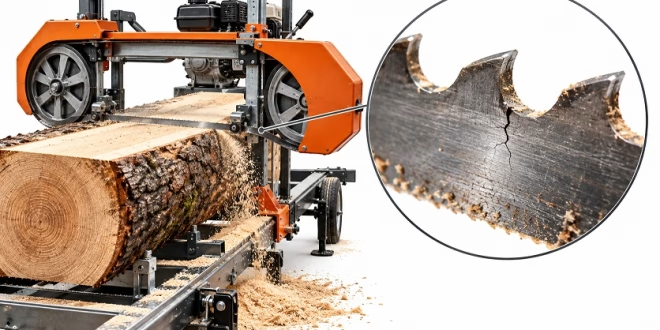
Fall is when many Canadian landowners fell the trees they plan to mill, and the sawing often carries on into winter with logs that are partly frozen. That is also when a common surprise arrives. Many band sawmill blades are retired not because the teeth will no longer cut, but because a hairline crack has opened at the base of a tooth and the band is close to snapping.
Every trip around the wheels bends the band
A band blade is a thin loop of hardened steel running around two wheels. Each time a section of it passes over a wheel it bends into a curve, and each time it leaves the wheel it straightens again. At normal sawing speed, every part of the blade goes through that bend and release many times a minute.
Steel tolerates repeated bending for a long time, but not forever. Microscopic cracks form where stress concentrates, and on a band blade that point is the rounded bottom of each gullet, the curved space between teeth. Once a crack starts there, each further lap around the wheels opens it a little more.
Why dull bandsaw mill blades crack sooner
Blunt teeth do not slice fibers cleanly, so the operator pushes the head harder to keep the cut moving. That extra feed pressure bends the band backward in the cut and generates heat, and both add stress at exactly the gullets where cracks begin.
This is why sharpening early extends the life of bandsaw mill blades rather than shortening it. A blade touched up after a modest amount of sawing does less work per board, runs cooler and flexes less, so it survives more laps before fatigue ends its life.
What does the gullet actually do?
Each tooth removes a small amount of wood as sawdust, and that sawdust has to go somewhere until the tooth leaves the log. The gullet is the pocket that carries it. When it leaves the far side of the cut, the dust falls out and the pocket is empty for the next pass.
Wide logs and fast feed rates ask each gullet to hold more dust than it can carry. The excess packs into the cut around the blade, friction climbs, and the band heats and flexes, leaving boards with a wavy surface. Slowing the feed on the widest cuts often does more for board quality than any adjustment to the mill.
Hook angle and set follow the wood, not the machine
The hook angle is how far each tooth leans forward into the cut. A more aggressive hook bites quickly into soft pine and spruce, while hard maple and frozen logs cut more cleanly with a milder angle that is less inclined to grab. Portable sawmill blades are sold in several tooth profiles for exactly that reason, and keeping one profile for summer softwoods and another for winter hardwoods avoids forcing a single blade to do both badly.
Set is the small bend given to alternate teeth so the cut is wider than the band itself. Too little set lets the blade body rub and heat. Too much wastes wood and leaves a rough face. Resinous softwoods add another factor, since pitch builds up on the blade, and a light water drip with a little soap keeps it from accumulating.
Reading the sawdust
The material coming out of the cut is the quickest guide to what the blade is doing, and it is available on every pass without stopping the mill. Watching it for a few boards at the start of each session catches most problems before they show up as cracked or wavy stock.
- Coarse, even chips: sharp teeth, feed rate about right
- Fine powder: teeth dulling or feed too slow
- Dust packed on boards: gullets overloaded, slow the feed
- Sticky dark buildup on the band: pitch, add lubrication
Band saw blades used in a workshop show similar signs on a smaller scale, but on a sawmill the effect is amplified by the length of each cut and the size of the log. A problem that barely marks a short cut in a shop can ruin the full length of a long board.
Release the tension when the day ends
A band left tightly tensioned overnight keeps its steel under constant load and can press flat spots into the wheel belts. Backing the tension off after the last cut, and restoring it before the first cut the next day, is one of the simplest habits for getting more cuts from each blade.
Inspection belongs in the same routine. Before sending sawmill blades out for sharpening or setting them on a grinder, shine a flashlight along the gullets and look for the fine line of a starting crack. A cracked band sharpened and refitted is a band that fails in the middle of a log.
That habit matters more than the price per blade. Sawmill blades for sale in multi-packs can look expensive or cheap depending on the pack size, yet the number that decides the real cost is how many boards each blade produces before it cracks. The Ripper37 bands that TMG Industrial carries for its PSM26 mill are made in the United Kingdom, and like any band they return that investment only when they are sharpened early and rested between sawing days.