A connector sample request works best when it describes the finished assembly that will be evaluated. Procurement teams often receive broad requirements such as a waterproof connector for a sensor or an outdoor unit, but that wording leaves important questions unanswered. The request should identify the mating parts, equipment interface, cable or panel installation, operating exposure, and the evidence needed before a production decision. Clear inputs produce samples that are more likely to answer the real design question.
Start with the counterpart. If the equipment already has a connector interface, collect the existing part information, drawings, photos, and any known coding or contact details. If the interface is new, define both sides as a pair. A supplier cannot reliably assess fit from a generic name alone, and a buyer cannot compare alternatives when the mating assumptions differ. Keeping the two sides visible in the request is a simple way to prevent an incomplete sample review.
Next, describe the installation state. State whether the sample will be used as a cable-end part, a panel interface, or an assembly with a specific cable construction. Include the available space, cable direction, mounting side, and any need for field assembly or factory termination. These details affect not only the product choice but also the method by which the sample should be prepared and the kind of inspection that will be meaningful.
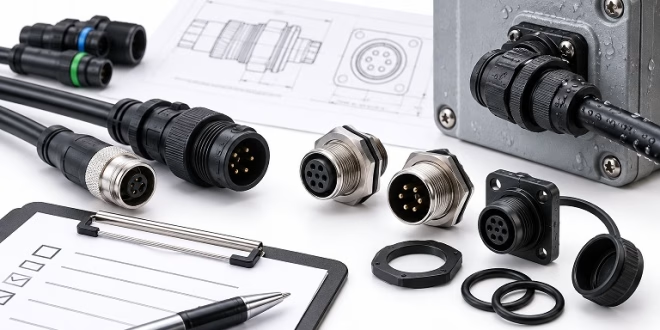
For an initial family-level search, buyers can use waterproof circular connectors to compare M5, M8, and M12 options and related mounting approaches. The purchase request should then narrow the family to a defined mating arrangement, application setting, and sample objective so the quotation and evaluation are comparable.
Environmental requirements should be framed as test conditions rather than broad adjectives. Explain where water, dust, cleaning agents, oil, temperature changes, or vibration may reach the connection. State whether the requirement applies while the connector is mated, during storage, with a cap in place, or after panel installation. This phrasing helps engineering and suppliers discuss the correct assembly state and avoids treating a single rating statement as a substitute for a complete validation plan.
A useful sample plan also assigns decisions to owners. Engineering may confirm fit, circuit compatibility, and cable routing. Manufacturing may review assembly access and repeatability. Quality may identify documentation or inspection evidence needed before approval. Purchasing can collect pricing, lead-time assumptions, and alternative configurations. When these responsibilities are named early, a sample does not sit waiting for an undefined approval or get accepted by one team while another discovers a problem later.
Create an evaluation record that can follow the part through the project. The record should capture the requested configuration, received configuration, mating result, installation observations, cable or panel fit, notable limitations, and the next action. Add photos of the installed sample where helpful. This becomes valuable when a later order is placed, when a design changes, or when a second site needs to understand why a particular interface was selected.
Good procurement discipline turns a sample into evidence rather than a box of components. By specifying the counterpart, installation method, exposure, and approval questions in advance, the buyer creates a fair basis for technical and commercial comparison. The final decision can then rely on a mated, installed evaluation and a written record of what the selected configuration is expected to do in the actual equipment. When more than one supplier sample is under review, use the same installation fixture and acceptance notes for every candidate. This keeps the comparison grounded in the application rather than presentation differences between individual sample packages. Record unanswered questions separately from failures so the team knows whether to request clarification, a revised sample, or a different configuration. A consistent process gives purchasing a defensible decision trail and makes later reordering less dependent on memory.