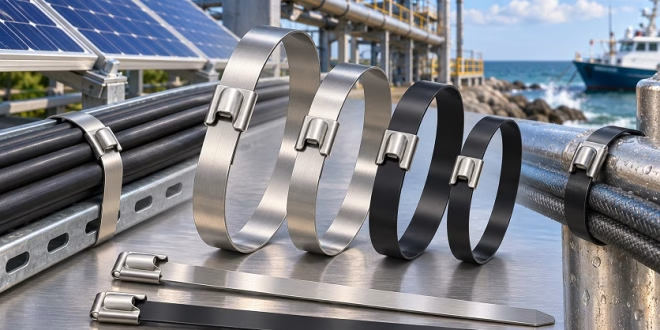
Plastic cable ties do a great job indoors. Outdoors, near salt water, or close to heat, they crack, fade, and let go. When a failed tie means a loose cable on a solar tracker or a pipe bundle swinging on an offshore deck, the cheap part becomes the expensive one.
That is where stainless steel cable ties come in. But "stainless" is not one product. The grade, the coating, and the locking style all change how long a tie lasts. This guide walks you through each choice so you buy the right tie the first time.
Why Stainless Steel Instead of Nylon?
Nylon 66 ties are light, cheap, and easy to fit. They also have clear limits:
- UV light breaks nylon down over time, even with black UV-stabilised grades.
- Heat softens nylon well before 150 °C, so it is a poor fit near exhausts, ovens or hot pipes.
- Fire melts plastic ties, which can drop cables in a tunnel or building at the worst moment.
- Chemicals and salt make plastic brittle over the years.
Stainless steel ties handle a much wider temperature range, do not burn, and hold their strength for years in sun and rain. For permanent outdoor or industrial work, they usually cost less over the life of the job.
304 vs 316: The Grade Decision
Most stainless steel cable ties come in two grades.
Grade 304 is the standard choice. It resists rust well in normal outdoor air, rain, and most industrial sites. Use it for general outdoor cabling, building services, signage, rooftop runs and inland solar farms.
Grade 316 adds molybdenum, which gives it much better resistance to chlorides. Chlorides come from sea spray, road salt, swimming pools and many chemical plants. Use 316 for:
- Marine vessels, ports and offshore platforms
- Coastal solar and wind sites
- Chemical, food and wastewater plants with harsh wash-down
- Any site within a few kilometres of the sea
A simple rule: if salt can reach it, choose 316. If not, 304 is usually enough and costs less.
Coated or Uncoated?
Bare stainless ties are strong and simple. A coating adds protection in three cases:
- Cable jacket protection. The edge of a bare steel band can cut into soft cable insulation under vibration. A polyester or PVC coating gives a smooth surface.
- Galvanic corrosion. When stainless steel touches aluminium (for example, solar mounting rails), the two metals can corrode each other in damp air. A coated tie keeps them apart.
- Colour coding. Coated ties come in colours, which helps crews identify circuits or phases at a glance.
For solar arrays on aluminium rails, a coated tie is often the safer choice.
Ball-Lock vs Ladder-Lock
The locking head decides how easy the tie is to fit and how well it holds.
- Ball-lock (self-locking) ties use a small ball in the head. Push the band through, and the ball locks it at any point. They are quick to fit and the most common type.
- Ladder-type ties have notches along the band and lock in steps. They suit jobs that need a very high hold or repeated tension checks.
- Releasable stainless ties exist for temporary work, but they are not for permanent fixing.
Size and Strength
Pick the width for the load and the length for the bundle:
- Width sets tensile strength. A 4.6 mm tie suits light cable runs. Wider 7.9 mm and 12 mm ties suit heavy bundles, pipe and signage.
- Length should wrap the bundle with room to pass through the head and tension it. Measure the bundle diameter and allow for growth if more cables will be added later.
Always check the rated loop tensile strength on the datasheet, not just the band size.
Installation Tips That Prevent Failures
- Use a proper tensioning tool. Hand tightening leaves ties loose; a tool tensions and cuts the tail flush in one action.
- Cut flush. A sharp tail left sticking out can injure workers and snag cable jackets.
- Do not over-tighten on soft cables. Steel will crush insulation that nylon would not.
- Space ties evenly along a run to share the load and stop cables sagging.
Buying in Bulk: What to Ask Your Supplier
If you buy for projects, distribution, or repeat production, the supplier matters as much as the tie. Ask for:
- A mill or material certificate confirming 304 or 316 grade
- Tensile test data for the exact width and length you order
- Consistent band thickness and edge finish from batch to batch
- Custom lengths, coatings, colours and private-label packing if you resell
Buying direct from an experienced stainless steel cable ties manufacturer gives you more control over all of these points, plus factory pricing on volume orders. Many distributors now source cable ties from China for exactly this reason: a wide range of grades and sizes, custom options, and steady quality at bulk volumes.
Quick Selection Checklist
- Near salt, chlorides or chemicals? Choose 316. Otherwise 304.
- Touching aluminium or soft cable jackets? Choose a coated tie.
- Need fast fitting? Choose ball-lock.
- Match width to the load and length to the bundle.
- Install with a tensioning tool and cut flush.
The right stainless steel cable tie fits once and stays put for years. Spend five minutes on grade, coating and size, and you avoid the far bigger cost of going back to fix failed ties in the field.