If you've been following ESP32 tutorials for a while, you've probably built your share of Wi-Fi weather stations, Bluetooth-controlled robots, and sensor dashboards. The ESP32 has been the go-to board for makers who want connectivity without the complexity of a full Linux SBC like the Raspberry Pi.
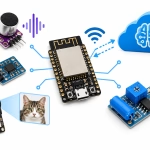
But here's what's changed in the last couple of years: the bar for "interesting ESP32 project" has moved. Running a small neural network on the chip — locally, without cloud round-trips — is no longer a demo trick. It's becoming a real product requirement. And the latest ESP32 variants were designed with exactly that in mind.
Why the ESP32 Family Keeps Evolving
The original ESP32 gave us dual-core processing, Wi-Fi, and Bluetooth in a package that cost less than a decent lunch. For most hobby projects, it's still more than enough.
But as makers started pushing into voice-controlled devices, camera-based smart sensors, and offline keyword detection, the limitations became clear:
- No hardware acceleration for math-heavy ML operations
- Limited USB support (you often needed a bridge chip)
- Camera interfacing was awkward and underpowered
Espressif addressed these gaps with the ESP32-S3, ESP32-S31, and newer variants. The S3, for instance, added SIMD vector instructions specifically for neural network inference, native USB OTG, and a proper camera interface. The S31 went further with a RISC-V core and Wi-Fi 6.
Understanding the full esp32 features across these variants matters when you're choosing a board for a project that goes beyond blinking an LED.
Where Edge AI Changes the Game
Consider a simple project: a smart doorbell that recognizes whether someone is at the door before sending a notification. With the original ESP32, you'd capture a frame, upload it to a cloud API, wait for the response, and hope your Wi-Fi holds up. Latency, privacy concerns, and dependency on internet connectivity — all problems.
With an ESP32-S3 running a lightweight model on-device, the inference happens in milliseconds on the board itself. No cloud needed. No data leaves your hardware. The project goes from "works if everything is perfect" to "works, period."
This is the same shift happening in commercial IoT products, and it's a shift you can experiment with on a $5 development board.
The Software Side: Don’t Reinvent the Wheel
Hardware is only half the story. The other half is the software stack — the SDK, the cloud connectivity, the OTA update mechanism, the AI integration layer.
This is where many maker projects stall. You get the model running on the chip, and then you need to figure out:
- How to connect the device to a cloud dashboard
- How to push firmware updates without physically flashing each board
- How to integrate an LLM for conversational features
- How to handle device authentication and data encryption
That's the kind of infrastructure that's tedious to build from scratch but essential for anything beyond a weekend demo.
An open-source framework like TuyaOpen bundles these layers together — a cross-platform C/C++ SDK that works across ESP32, Raspberry Pi, and Tuya's own chips, plus cloud integration, multimodal AI support (ChatGPT, Gemini, Qwen, and others), and OTA update paths. It's designed so you can go from a working prototype to something shippable without rewriting your entire stack.
What to Try Next
If you want to start experimenting with AI on ESP32, here's a practical progression:
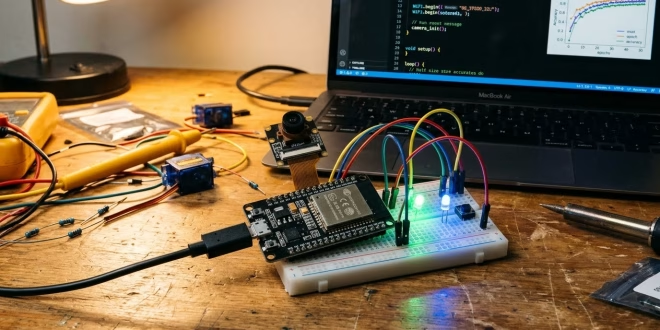
- Start with a basic sensor project on your current ESP32 board — get comfortable with the Arduino framework and Wi-Fi connectivity
- Move to an ESP32-S3 board and try running a TinyML model — Espressif's examples and the TuyaOpen SDK both have starter projects
- Add a camera module and experiment with on-device image classification
- Connect to a cloud AI service for features that need heavier processing — voice assistants, LLM-based responses
- Build a complete product prototype with OTA updates, a mobile dashboard, and proper device security
The gap between "maker project" and "real product" is smaller than it used to be. The tools are better, the chips are more capable, and the open-source ecosystem has caught up. All you need is a board and a weekend to start.