Making one sandwich panel is fairly straightforward. A manufacturer places an insulating core between two outer skins, bonds the layers, and presses them together. Producing dozens of panels in a shift is a different challenge. Workers must keep the materials aligned, apply the right amount of adhesive, and move heavy assemblies between stations without disrupting the process.
That is where industrial automation makes a difference. Instead of asking an operator to start and stop every machine, a control system coordinates conveyors, adhesive pumps, valves, and presses. Sensors tell the controller what is happening on the line, while motor drives and pneumatic actuators carry out its commands.
These are the same basic ideas behind many small electronics projects, but the stakes change when the equipment handles large panels and powerful machinery. Let's look at how the manufacturing process works, then follow the signals that keep an automated sandwich panel production line moving.
Sponsored content: This article was prepared in collaboration with GlueStream.
Automation Coordinates the Main Stages of Sandwich Panel Manufacturing
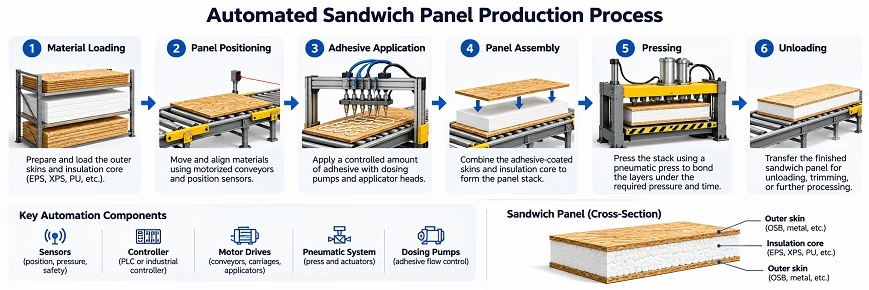
A sandwich panel usually has two outer skins surrounding a lightweight core. Structural insulated panels (SIPs), for example, commonly pair oriented strand board (OSB) skins with expanded polystyrene (EPS) or another suitable insulating core. Other designs use metal, PVC, or fiberglass-reinforced skins. The materials vary, but the manufacturing challenge remains similar: each layer must reach the right position and form a dependable bond with its neighbors.
A production line divides that work into several stages. Material handling moves the components into place, adhesive equipment coats the required surfaces, and a press holds the assembly together while the bond develops. Automation links those stages so one machine does not interfere with the next.
Material Handling and Panel Positioning
Production starts with panels, boards, and insulation cores cut to the required dimensions. Operators may load them by hand, with lifting equipment, or through automated feeders. Once the materials reach the line, powered rollers or movable carriages carry them toward the assembly area. This removes much of the repeated lifting and pushing from the process.
However, moving a panel is only half the task. The line must also know where it is. A photoelectric sensor might detect the leading edge of a board, while a limit switch could confirm that a carriage has reached its stop. The controller uses these signals to stop a motor at the right moment or allow the next operation to begin. If the material never reaches the expected position, the machine should report a fault instead of continuing blindly.
Automated Adhesive Application
Once the material reaches the gluing station, the system must spread adhesive across the intended bonding surface. Uneven coverage can leave poorly bonded areas, while too much adhesive adds cost and may complicate handling. Manual application also becomes harder to repeat as panel sizes and production volumes increase.
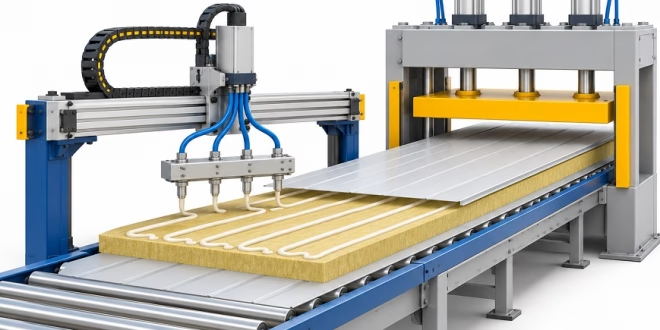
An automatic applicator addresses this problem with a dosing pump and a controlled application head. The pump meters adhesive from a tank or drum, while the head distributes it through multiple outlets. Electric drives move the applicator or the panel, depending on the machine design. The controller coordinates that motion with dispensing so the equipment applies adhesive where the material actually sits. Some systems also switch nozzle groups on or off to match different panel widths.
Pressing, Curing, and Unloading
After adhesive application, workers or handling equipment assemble the skins and core into a stack. The line then moves the stack into a press. Here, the machine applies force across the panel to keep the layers in contact as the adhesive develops strength.
Pneumatic presses use compressed air to drive cylinders. Solenoid valves direct that air, and the control system starts and ends the pressing cycle according to the process settings. The correct pressure and pressing time depend on the adhesive, panel construction, and equipment design. Operators must follow the specified process rather than assume that every panel needs the same cycle.
Once the cycle finishes, the press releases the stack and the handling system transfers it toward unloading. The result is a repeated sequence of movement, dispensing, assembly, pressing, and transfer instead of a collection of unrelated manual steps.
Four Control Requirements for Automated Production Lines
Connecting these machines is not enough to make the line reliable. The controller must understand where materials and actuators are, decide what should happen next, and handle unexpected conditions. Four requirements shape that design.
Reliable Sensor Feedback
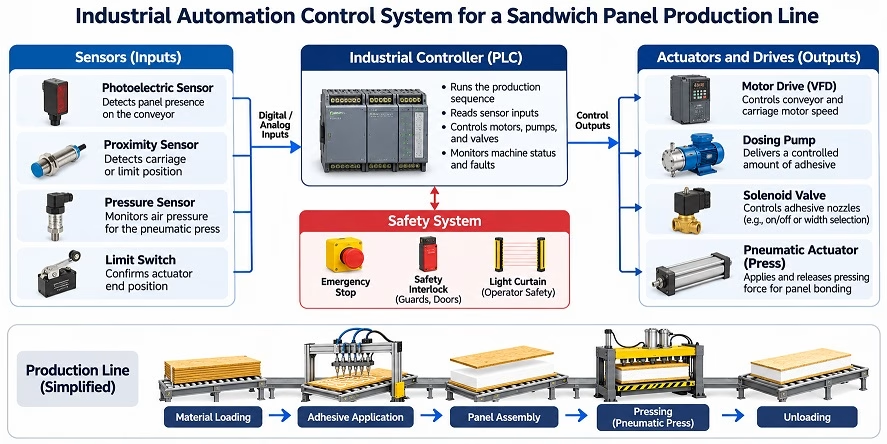
A controller cannot directly see a panel or feel the force of a press. It relies on electrical signals from sensors. Photoelectric sensors can detect incoming boards, proximity switches can indicate the position of a moving mechanism, and pressure transducers can report changes in an air system.
The signal type matters as much as the sensor itself. A digital input tells the controller whether a condition is true or false. An analog input provides a changing value, such as pressure. Engineers also need to account for dust, vibration, cable damage, and electrical interference. If a sensor gives a false reading, the controller may stop a good panel or attempt the wrong sequence.
Coordinated Motion and Process Sequencing
Industrial controllers, often programmable logic controllers (PLCs), turn sensor readings into actions. Instead of running every motor continuously, they move the line through defined operating states. For example, the controller may wait for a panel-position signal, stop the conveyor, enable the adhesive applicator, and then release the panel for transfer.
This sequence needs conditions between steps. The press should not accept another stack while its previous cycle is still running. Similarly, the conveyor should not move into a work area until the relevant mechanism has cleared it. These conditions, commonly called interlocks, prevent conflicting commands and make a complex line easier to diagnose.
Accurate Dosing and Actuator Control
The controller also needs to match actuator behavior to the process. A conveyor motor moves a panel, but an adhesive pump must deliver the required material at the same time. If panel travel speed changes without a corresponding dosing adjustment, the amount of adhesive per square meter can change too.
Variable-frequency drives help regulate compatible AC motors by controlling their operating frequency and voltage. In an adhesive station, drive control can adjust pump output to suit the required application rate. Pneumatic valves handle a different job: they open or close air paths to move cylinders or operate dispensing mechanisms. Each component serves a specific purpose, but the controller brings their actions together.
Machine Safety and Fault Detection
A stopped production line costs time, but an unsafe one can injure people. Presses create crush hazards, conveyors introduce pinch points, and pneumatic equipment can store energy even after a motor stops. Designers therefore need guards, appropriate emergency-stop functions, and safety-rated controls wherever the risk assessment requires them.
Ordinary PLC logic can report a missing sensor or an incomplete press cycle, but it should not replace a properly designed safety function. For example, an interlocked guard may need a safety circuit that prevents hazardous motion when someone opens it. During maintenance, workers must also isolate electrical and pneumatic energy according to the applicable procedures. Good diagnostics help technicians find faults; proper safeguards protect them while they do so.
GlueStream Equipment for Automated Sandwich Panel Manufacturing
The control principles above appear in real manufacturing equipment. GlueStream develops machinery for applying adhesives and assembling sandwich panels, with configurations that range from individual workstations to integrated lines. Its published designs provide a useful example of how mechanical equipment and electronic control fit together.
Automated Adhesive Application Systems
GlueStream's Sandwich panel equipment includes the SPL-10M adhesive-applying portal. Rather than relying on workers to spread adhesive over a large board, this machine uses a moving applicator and a metering system to cover the intended surface. The applicator can adjust its height to suit the material stack, while controlled valves help set the active application width.
The company describes a precision dosing pump that works with frequency converters to regulate adhesive delivery. For the relevant SPL-10M configuration, GlueStream states an application accuracy of ±5 g/m². That figure is a manufacturer specification, not an independent measurement, and actual results depend on the material and process setup. Still, it illustrates why manufacturers pay close attention to dosing control: even small variations matter across large bonding surfaces.
The equipment also addresses a problem specific to moisture-curing, one-component polyurethane (PUR) adhesives. Because moisture starts their curing reaction, adhesive left exposed inside a nozzle can harden and block it. GlueStream uses an automatically closing shutter tray with protective liquid to cover the nozzle area during stops. This small mechanism helps the applicator prepare for its next cycle without unnecessary cleaning or material loss.
Integrated Production Lines and Pneumatic Presses
An adhesive applicator solves only one part of the process. Panels still need to travel to assembly and pressing stations, and those machines must share a predictable sequence. GlueStream's ASPL-10M.2P Sandwich Panel Production Line shows how a manufacturer can connect the stages.
According to its product documentation, the ASPL-10M.2P combines an SPL-10M mobile adhesive portal, a motorized roller conveyor, an automatic distribution platform, two P-type pneumatic presses, a glue pump station, and a control cabinet. The conveyor and distribution platform transfer material through the line, while the presses hold assembled panels during the bonding stage. Operators still take part in the workflow, but the machines handle much of the repeated transport and processing.
This arrangement also shows why overall production speed depends on more than a fast adhesive head. A panel cannot leave the pressing stage before the process allows it, and an incoming stack needs a free destination. By coordinating these stations, the line can reduce unnecessary waiting and keep the equipment working in an orderly sequence. Actual output still depends on panel size, materials, adhesive requirements, staffing, and the selected machine configuration.
Remote Diagnostics and Production Flexibility
Even a well-designed line occasionally needs adjustment or troubleshooting. A position sensor may fail, a motor drive may report an error, or a dispensing parameter may need attention. Local diagnostic displays give operators a starting point, while remote support can help specialists investigate problems without immediately traveling to the factory.
GlueStream advertises remote-access modules and online technical support for its machinery. These features can make technical assistance more convenient, although customers should still control network access and define who may change machine settings. Remote connectivity does not replace on-site inspection, routine maintenance, or safety procedures.
Manufacturers also need to choose equipment that fits their process. The right arrangement depends on panel dimensions, adhesive chemistry, expected output, floor space, compressed-air capacity, and how much manual handling the operation can accommodate. Automation works best when engineers design around those practical limits instead of treating every production line as interchangeable.
Conclusion
An automated sandwich panel line may look very different from a microcontroller project on a workbench, but both rely on the same basic control loop. Sensors report what is happening, a controller chooses the next action, and electrical or pneumatic actuators carry it out. The difference lies in the scale of the machinery and the demands on reliability, timing, and safety.
In panel manufacturing, those controls help coordinate material positioning, adhesive application, pressing, and unloading. GlueStream's equipment shows how manufacturers can combine these functions into a working production system. For anyone studying electronics or embedded control, it is a practical reminder that understanding sensors, motor drives, and sequencing opens the door to much larger industrial applications.