February 6, 2023
Arduino Tutorial
An Arduino’s EEPROM, depending on the type of board, can store up to 4 KB of data. The Arduino UNO, in particular, stores 1024 bytes or 1024 ASCII characters. With that space, how can we store a sentence? Or a paragraph? This is what this article is all about.
Read More »
February 6, 2023
Arduino Tutorial
An array is a data structure for storing multiple variables of the same data type. Mastering arrays will definitely make your Arduino sketches more efficient. If you’re a beginner when it comes to Arduino array, then this tutorial is for you.
Read More »
February 6, 2023
Arduino Tutorial
The Arduino platform runs on C++ and with this comes all the pros (and cons) of the language. One of those pros is the use of classes and in general, object oriented coding. This article aims to guide you in creating your own Arduino classes which can make your sketches …
Read More »
February 6, 2023
Arduino Tutorial
The Arduino platform supports math functions like sine, cosine, logarithm, exponential, etc. But can it solve higher math problems like calculus? This two-part tutorial will show you how to make a sketch for Arduino integrals and differentials solver.
Read More »
February 6, 2023
Arduino Tutorial
Pointers can be confusing to beginner Arduino programmers. This tutorial aims to help you understand the concept of pointers by looking at software and hardware points of view.
Read More »
February 6, 2023
Arduino Tutorial
Structs (short for structure) are far less common in Arduino programming because they are mostly used in C whereas Arduino is based on C++. However, they are still a very useful tool especially if there is a need for a user-defined data set. This tutorial aims to help you understand …
Read More »
February 6, 2023
Arduino Tutorial
Here we are with another tutorial on Arduino programming. This time, we will look at static variables and how you can use them to your advantage. You may need to read about functions and classes before going through this one. What is a Static Variable? A variable is known to …
Read More »
December 31, 2022
Arduino Tutorial
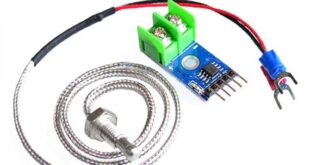
Temperature is a very common parameter in all of science and engineering. The behavior of electronic components drastically changes with temperature; storage of food and medicine relies on the correct temperature; getting the right metal type depends on how much heat is applied; fever means our body temperature goes beyond …
Read More »
September 26, 2022
STM32 Tutorial
The serial port is the most usual comm channel between a microcontroller and a computer. However, the different voltage levels and loss of the RS-232 port in modern computers led to the use of USB-TLL converter chips like CH340, CP2102, etc. This is what happens in the NodeMCU ESP8266 and …
Read More »
June 5, 2022
STM32 Tutorial
Needless to say, a serial output is a necessary tool in debugging embedded system applications. Placing the right messages in the right place will help you save hours in figuring out what went wrong in your code. Arduino programmers are very familiar with Serial. print() and its derivatives. But how can …
Read More »