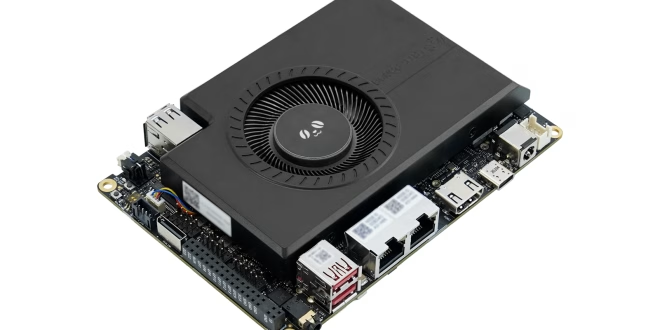
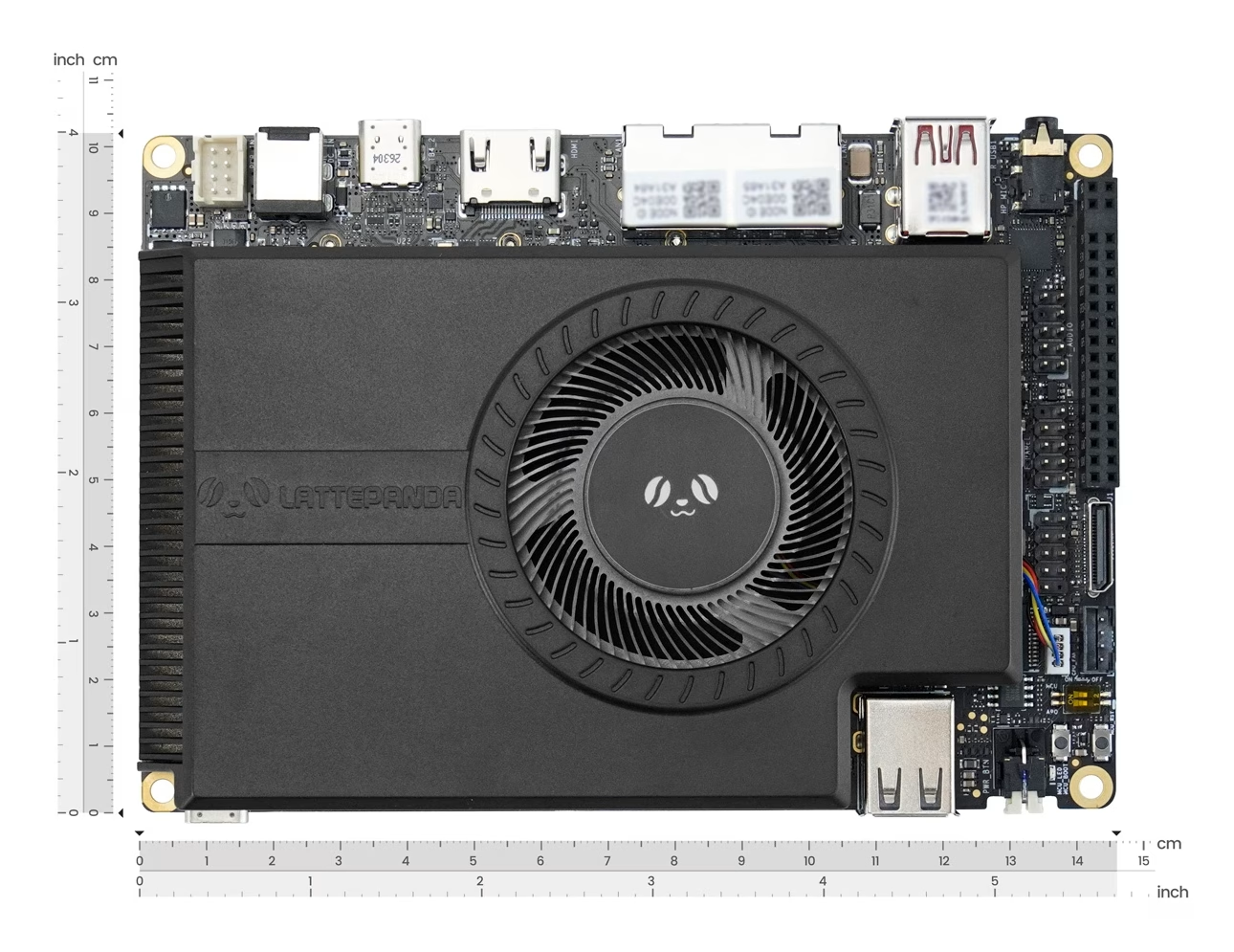
LattePanda has launched the Sigma 2, an x86 single-board computer designed for running AI models locally. The new board combines an Intel Core Ultra X7 358H processor, Intel Arc B390 graphics, and an RP2350 microcontroller in a 146 × 102 mm form factor.
Announced on October 22, 2026, the Sigma 2 targets developers building autonomous robots, industrial equipment, computer vision systems, and private AI servers. It offers up to 180 TOPS of combined peak AI performance, 64GB of LPDDR5X memory, and multiple high-speed expansion interfaces.
Unlike a conventional mini-PC, the Sigma 2 also provides programmable GPIO through its onboard microcontroller. Developers can therefore run AI inference and interact with external electronics from the same board.
Intel Core Ultra X7 358H Powers Local AI Processing
At the center of the Sigma 2 is Intel's Core Ultra X7 358H processor. It has 16 CPU cores, consisting of four performance cores, eight efficiency cores, and four low-power efficiency cores, with a maximum clock speed of 4.8 GHz.
The processor also integrates an Intel Arc B390 GPU with 12 Xe-cores and an NPU dedicated to AI acceleration.
According to LattePanda, the three processing components provide the following peak INT8 performance:
| Processing unit | Peak AI performance |
|---|---|
| Intel Arc B390 GPU | 122 TOPS |
| Intel NPU | 50 TOPS |
| CPU | 8 TOPS |
| Combined peak | 180 TOPS |
These figures represent theoretical peak computing capability across the different processing units. They should not be interpreted as the performance available to a single AI model, since actual inference speed depends on the model, framework, memory usage, and execution hardware.
The Sigma 2 includes 64GB of dual-channel LPDDR5X-8533 memory, providing a theoretical bandwidth of 136.5 GB/s. Up to 59GB of system memory can be allocated to the integrated GPU.
This shared-memory architecture allows larger quantized models to run without requiring a separate graphics card with equivalent dedicated VRAM. LattePanda says the board can accommodate 35-billion-parameter-class mixture-of-experts (MoE) models, although real-world performance will depend on the selected model and quantization method.
For developers working with local language models, the additional memory capacity may be particularly useful when running AI agents, retrieval-augmented generation systems, or applications that need to process long conversations.
RP2350 Microcontroller Adds Hardware Control
One of the Sigma 2's more interesting features for embedded developers is its integrated RP2350 microcontroller.
While the Intel processor handles operating-system tasks and AI inference, the RP2350 can manage lower-level hardware operations independently. It provides GPIO interfaces for connecting sensors, switches, actuators, and other electronic components.
The microcontroller supports common embedded interfaces, including I2C, SPI, UART, and analog inputs. It also comes with MicroPython firmware preloaded, allowing developers to begin writing hardware-control applications without setting up a separate development environment.
Consider a vision-based sorting system. The Intel processor could run an object-detection model to identify items passing through a camera's field of view. The RP2350 could then read position sensors and control the actuators responsible for sorting those items.
Separating high-level computing from hardware control can also help prevent operating-system scheduling delays from affecting time-sensitive GPIO operations.
This combination makes the Sigma 2 more than a compact AI server. It provides a platform for projects that need substantial computing power alongside direct interaction with physical hardware.
High-Speed Networking and Expansion
The Sigma 2 provides several expansion options for developers who need additional storage, networking, or computing hardware.
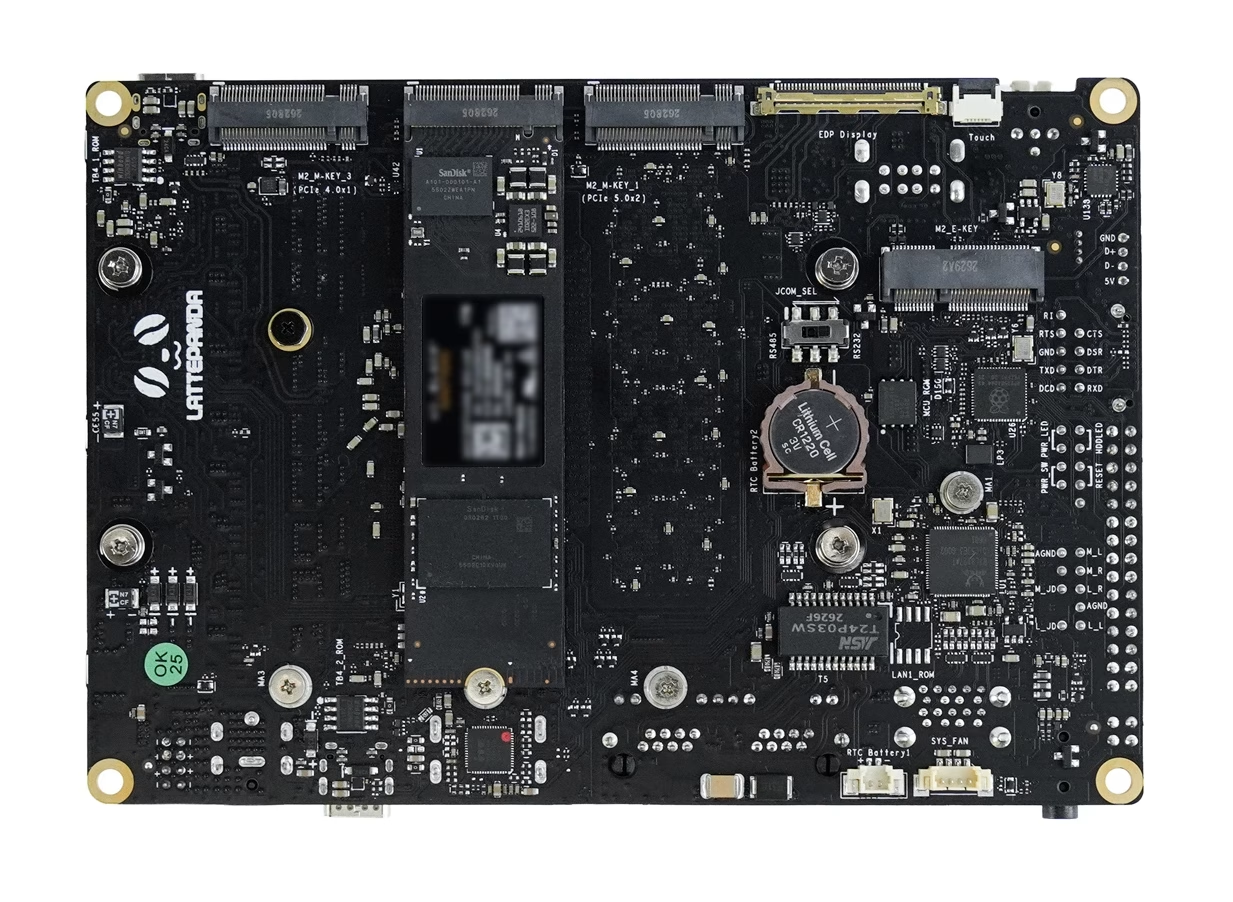
It includes three M.2 M-Key slots for NVMe storage and compatible accelerator modules, plus an M.2 E-Key slot for wireless connectivity. The M-Key interfaces support PCIe 5.0 x2, PCIe 4.0 x4, and PCIe 4.0 x1, respectively.
An OCuLink connector exposes PCIe 4.0 x2 for external devices, while two Thunderbolt 4 ports provide additional high-speed connectivity. External graphics docks and AI accelerators can expand the system's capabilities, although developers should account for the bandwidth limits of each interface.
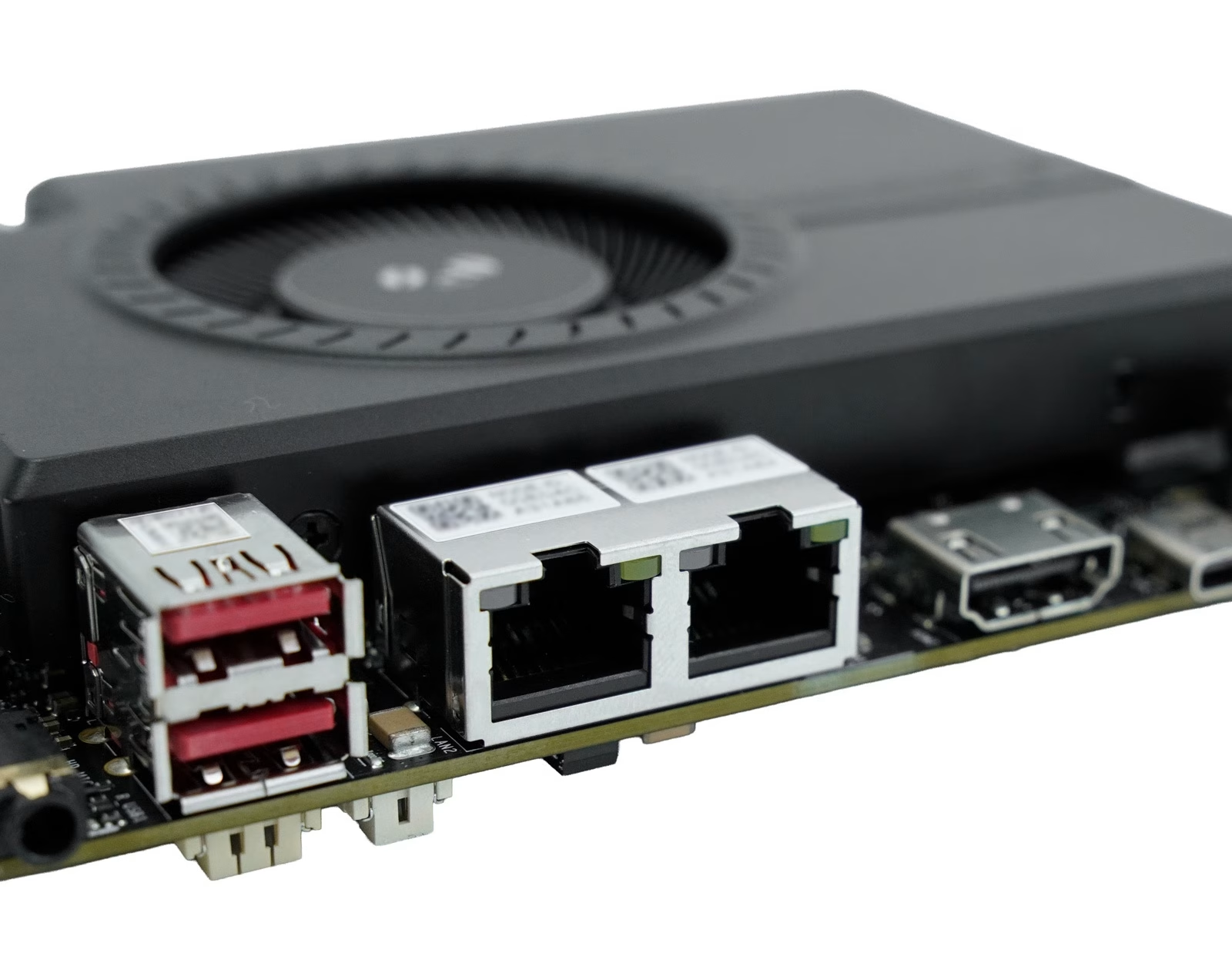
Networking is handled by two 10Gb Ethernet ports. These are useful for applications involving large datasets, network-attached storage, and high-bandwidth camera or sensor systems.
For conventional peripherals and displays, the board provides two USB 3.2 Gen 2 ports, two USB 2.0 ports, HDMI 2.1, DisplayPort 2.1 through USB-C, and an embedded DisplayPort interface.
It also includes an RS-232/485 header, making it suitable for integration with equipment that uses industrial serial communication.
The board measures 146 × 102 mm, allowing it to fit inside relatively compact enclosures despite its extensive connectivity.
Software Support and Local AI Development
The Sigma 2 supports Windows 11 and Ubuntu 24.04 LTS or later.
The available configuration includes a 1TB NVMe SSD with Ubuntu preinstalled. According to LattePanda, the supplied software environment also includes GPU and NPU drivers, OpenVINO Model Server, OpenClaw, and local AI models.
Developers can use AI frameworks such as Intel OpenVINO, Ollama, and llama.cpp to build applications that perform inference on the device.
For instance, OpenVINO provides acceleration options for supported models using Intel processing hardware. Ollama and llama.cpp provide other approaches to running language models locally.
Keeping inference on the device can reduce dependence on external cloud services, particularly in systems where internet connectivity is limited or data must remain within a local network.
However, developers still need to evaluate model compatibility, inference speed, and power consumption for their intended applications.
Applications Beyond AI Development
The Sigma 2's combination of computing performance and hardware interfaces makes it suitable for several types of embedded systems.
In autonomous robots, the board could handle camera processing, object recognition, and navigation calculations while the RP2350 manages sensor inputs and actuator-control signals.
For industrial monitoring, its dual 10Gb Ethernet connections and local AI processing capabilities could support equipment that collects large amounts of sensor data and analyzes it without sending everything to the cloud.
The same hardware could also serve as a private AI server for running language models, document-processing systems, or automation agents within a local network.
Developers building measurement instruments may find the combination of high-speed processing, serial interfaces, and GPIO useful when connecting custom electronics to data-processing software.
Of course, these capabilities come with higher cost and power requirements than a typical microcontroller board. The Sigma 2 is better suited to applications that genuinely need x86 computing performance, substantial memory, and local AI acceleration.
LattePanda Sigma 2 Pricing and Availability
The LattePanda Sigma 2 is available for pre-order at $2,599, with promotional pricing scheduled to continue through mid-November 2026. After the pre-sale period, the listed price will increase to $2,799.
The advertised configuration includes the Intel Core Ultra X7 358H processor, 64GB LPDDR5X RAM, and a 1TB NVMe SSD.
For system integration, developers should also consider power and thermal requirements. LattePanda specifies a 15–20V DC supply rated for at least 120W, or a compatible 20V USB-C Power Delivery supply rated for at least 100W. The specified operating temperature range is 0–40°C.
At this price, the Sigma 2 is clearly aimed at professional development, specialized computing, and embedded AI applications rather than entry-level electronics projects.
Its main advantage is the ability to combine local AI processing, extensive expansion, high-speed networking, and microcontroller-based hardware control on a single platform.
More information is available through the official LattePanda Sigma 2 product page and technical documentation.
The board can also be ordered through DFRobot's LattePanda Sigma 2 product listing.
Editor's note: This article is based on the manufacturer's launch information and published technical specifications. TeachMeMicro has not independently tested the Sigma 2 or verified its AI performance claims.